Autumn shroud set

We had a wonderful morning hosting Kim Salmon and Dave Brown (Candlesnuffer) for breakfast before heading out to Steven and Tony’s farm. There was a chill in the air and we had a big mob of dead this time. A fox, possum, flying fox, white cockatoo, and two magpies all road carnage to put to rest on decomposition beds under the eucalyptus tree. Adam did the hard work as I became overseer and documented proceedings.

We also collected the Echidna, I had left too long. Mold had formed and the thick black ooze had hardened the canvas. I was unsure as to its final outcome. It would need washing off a long soak in vinegar and complete drying out, a hard task as winter encroached. Tepi played with Blondie who was very interested in the freshly defrosting bodies, a sweet possum was particularly enticing.

http://www.flickr.com/apps/slideshow/show.swf?v=71649

Animals, People: A shared Environment

The Australian Animal Studies Group (AASG) are holding their 4th Biennial AASG Conference in 2011: Animals, People – a Shared Environment. Its purpose is to “bring together animal theorists and scientists from a broad range of academic disciplines with representatives from non-government organizations, government officials from several nations and representatives from industry, to examine the interrelationships between human and nonhuman animals from cultural, historical, geographical, environmental, representational, moral, legal and political perspectives.” It is held in conjunction with the Environmental Futures Centre at Griffith University, Brisbane. I am looking forward to presenting at the conference in July. I submitted the following abstract:

Animals in Australian Painting explored through practice-led research
This paper examines how practice-led research in painting can enable an experiential understanding of a subject. In this case the subject is the relationship between human and non-human animals in Australia as expressed in painting. Distinct cultural perspectives impact on the levels of involvement between painter and subject, while approaches are informed by individual experience. Therefore my research becomes equally involved in particular intercultural realities in Australia; specifically fusions between Aboriginal and European culture and the intercultural phenomena that constitutes my own identity. Through examining material experiments in my own painting process and the painting traditions of Kunwinjku speakers from Western Arnhem Land, I discuss some current interrelations between human and non-human animals in Australia informed as it is by colonial and Aboriginal history. The theme of the conference ‘Animals, People – a Shared Environment’ can translate within arts practice through the use of materials animals also access or embody. This is a cultural activity that activates awareness of living in an environment shared with animals. Like the foundational practices of hunting and collecting to provide food and shelter shared by human and non-human animals, its practice has been severely reduced and altered by Industrial Capitalism. The impact of Industrial Capitalism on what constitutes this ‘Shared Environment’ is a given in the context of this paper, and emerges through practice despite my efforts to counter its cultural impact.

Completed works

All works featured are animal shrouds, all additional paint applied are natural ochres such as white (delek), yellow (garlba) from Kunwinjku country and some yellow and red from Yuin country. The black charcoal is from Lake Mungo. One work also features stitching using silk thread.

The site becomes embedded into the work as the wind blows the canvas edge over the body, adding marks made with dust, leaves and sunlight or by collecting additional matter such as droppings and tree sap. The bed springs, its frame and the wire mesh holding the body firmly in place also make impressions on the canvas.

The rosella, for example, has no additional pigment as the shroud/environment stains I felt were sufficient.

2011 shroud set

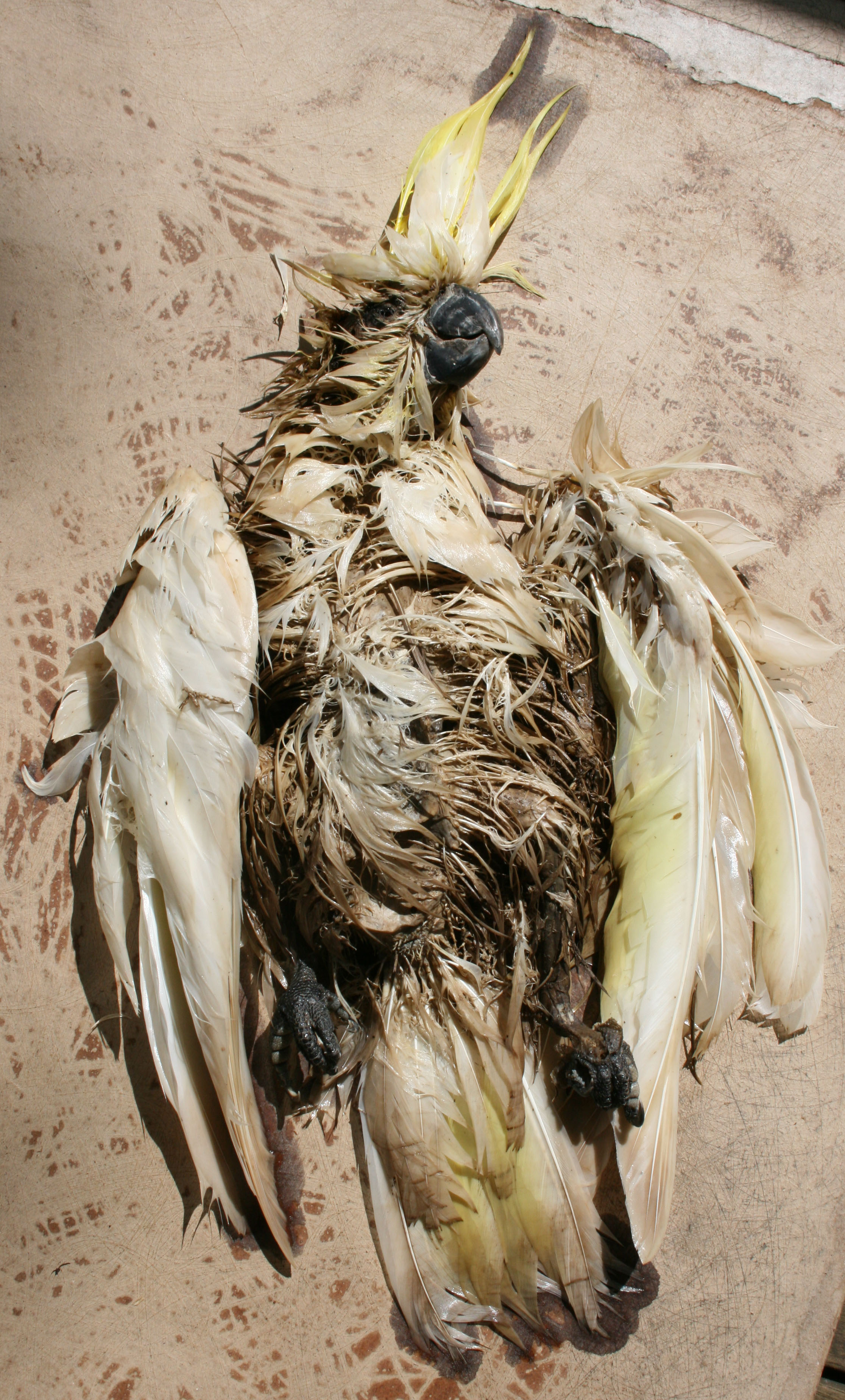
The return to the shroud site is always exciting. The bodies are exquisite to behold in their compelling grotesque beauty. The perfection as they lay in state gradually decomposing, but its what lay beneath, the hidden image that is revealed which I anticipate and seek. With all the debris still attached, feather and claws, dirt and blood, excrement, leaves, there is an embodied stain. But it is the cleansed stain, the returning smooth surface on which I wish to paint that compels me to brush most of it away. I may form attachments to a little remaining, as evidence of solid matter, to give the encounter a little more of process. While the magpie is alluring, it is the bottom cockatoo which surprises. Like an angel this image is born from death with white wings and blackened body, headless in flight. I play with its body still in tact, in love with its perfection in death and hang it on the shroud tree where a large spitfire crawls. The echidna is still too moist, I leave it, so frightened of a failure, longing for an imprint of its multiple spines.

http://www.flickr.com/apps/slideshow/show.swf?v=71649

new shroud set

Adam and I set up an echidna, two white cockatoos and a magpie with the help of Steven on Tony’s farm. Our daughter Tepi had a wonderful time chasing Blondie the dog on adventures, one of which ended in a frantic search for her. We found her crying at the top of the hill a bit sunkissed and missing a sock. The farm is green after all the rain, but sheep now struggle against grass seeds in the eye and flies armed with maggots. A forest of thistle now surrounds the shroud site and the tree is healthier, thick with leaves.

http://www.flickr.com/apps/slideshow/show.swf?v=71649

white cockatoos

On the same day I saw and collected one dried and one fresh white cockatoo body. The white feathers and yellow crest matching the delek pigments collected in Maburrinj. I placed the fresh bird in the freezer, and placed the dried one in metho. The latter had the sweeter smell of the drier stages of decomposition. Its body cavity is exposed, especially at the back, but its front, with its skeletal face and full crest in tact are what I wish to paint in my current work featuring the currawong.

cockatoo
cockatoo dried and soaked in metho left to dry

Studio Update

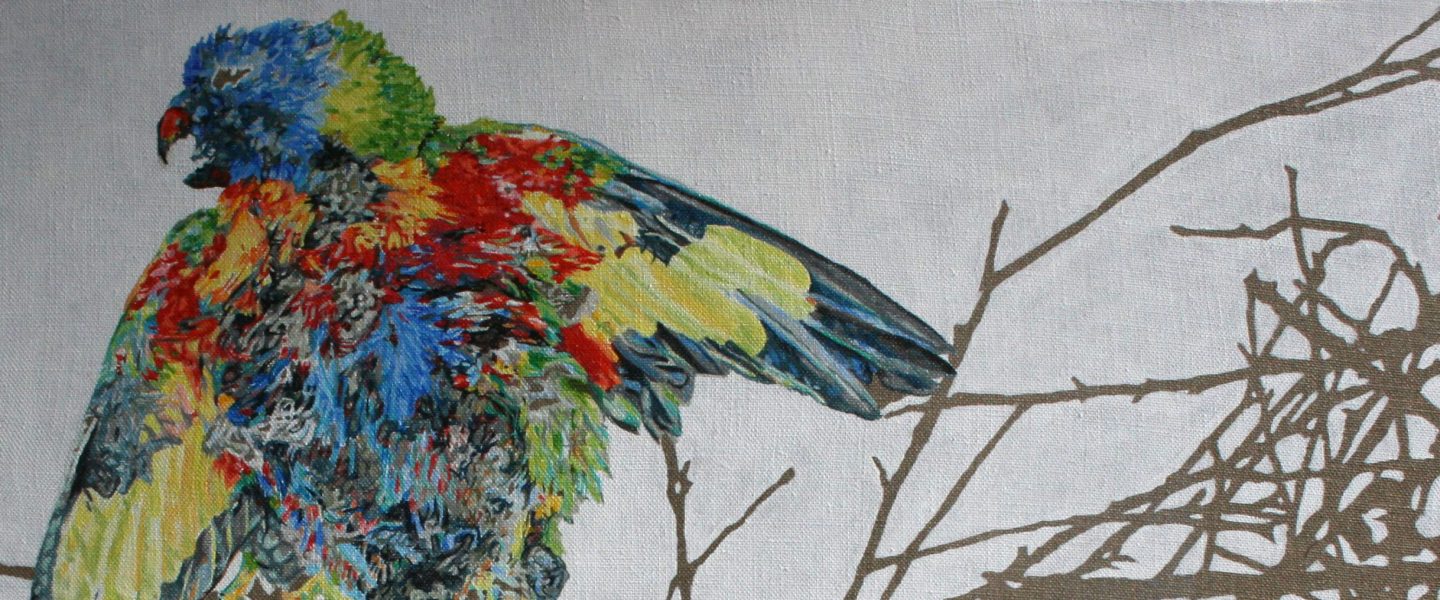
I am currently working on the Currawong shroud from January 2010 (refer to post). I began surrounding the stain with a nest created by painting delek in the negative space between the woven sticks. I stopped midway thinking I would like to define the currawong shape in a subtle way using silken thread stitches. I had been inspired last year by the brightness of silken thread amidst naturally dyed thread in the Indonesian/Malaysian tapestry on exhibition at the NGA. The result was more than I had hoped for, while being delicate and fine, as expressing care and refinement, an illusion was created of another plane. This was due to the assumption the shape was stitched on. The process of stitching is very intensive, the piercing of cloth ground at times smooth through a ready opening in the weave, or difficult when blocked by tightly woven threads. I thought of explanations of central Australian sand painting in Balgo in Piercing the Ground by Christine Watson, which I am currently reading, and also of my time as a tattooist. The woven body covering akin to skin.

Wamud at the MCA

This exhibition is not to be missed, a rare and valuable opportunity to see the dolobbo (bark) and djurra bim (paper paintings) produced by a painter who also produced kunwarrde bim (rock paintings) in the ancient way. His family were proud and informative at the opening, his grandchildren having produced a mural painting featuring his most familiar motifs in honour of his rock painting, bringing its familial significance to the city of Sydney.

Painting on bunny shrouds

In the studio I am now equipped with supplies of ochre from around Australia, shrouds produced last summer featuring birds and rabbits (treated with vinegar, dyed in eucalyptus, stretched and sealed with rabbit skin glue), and images of the placement of bodies before and after the decomposition process and a projector.

In the absence of a body, but the presence of a mark that embodies the presence of absence, I observe images of the full and desiccated body in a picture of light that communicates with the elusive tonal indicators present on a dank woven burial cloth. I fall into fascination with those indefinite stains, and resist further reconstruction of an internal presence.

In the first instance a particularly nebulous collection of fluid defies any visual recognition, so I introduce the silhouette simultaneously aware of the wire-mesh grid that also imprinted its dirt and rust stains inconsistently over the weave. I work from the projection of the whole body beneath the mesh using delek, the pure sacred shit of ngalyod, whiter than the whitest gesso. I define the in-between space of the mesh, as though the body is backlit and elevated in an alluvial substance. The body appears simultaneously arrested and freed, in motion and static, pure and defiled. The warping grid of mesh now replicates in the eye vibrating an after image that plays with any stains actually visible.

In the second instance a duel shroud offers, in part, some clearly defined limbs, stomach juices, even the suggestion of an eye, and I am held in the almost and slide predictably into the conversation between the light body and stain body. The results fall short of my expectations, there is a loss of curiosity and the compulsion to inquire, so I remove the evidence of my hand after playing minimally with the second bunny stain. Exploring the ochres from my own country (Yuin) I combine an orange-red with a yellow and draw the vertical mesh lines within the body only. It follows then the top bunny should contain the horizontal alternative.

http://www.flickr.com/apps/slideshow/show.swf?v=71649

Ngaraka

My supervisor Nigel Lendon alerted me to the existence of a burial platform replica across from my studio by the lake in front of Old Canberra House. It was a collaborative project to which Nigel contributed his skill in construction. It is attributed to Djon Mundine/Fiona Foley who initiated the concept and use kangaroo bones as a metaphor for human remains. It is titled Ngaraka: Shrine for the Lost Koori 2001 and mirrors my own yearnings for this type of burial practice in which the body and its decomposition play a major part in the mourning process. It could be said that the natural disintegration of the body following death defines the active and public period of mourning. A sense of closure is then physically experienced with the second burial when the bones are collected, in the north of Australia painted with red ochre, and ceremonially placed in a log coffin or rock crevice.

In my current painting process I have partly replicated this treatment of the dead by collecting recently deceased animals and placing them on a makeshift burial platform that uses spring based bed frames. This process was developed in order to collect bodily pigments on canvas creating a shroud. I am considering collecting the bones from the next set of shrouds, which I produce over the summer period.