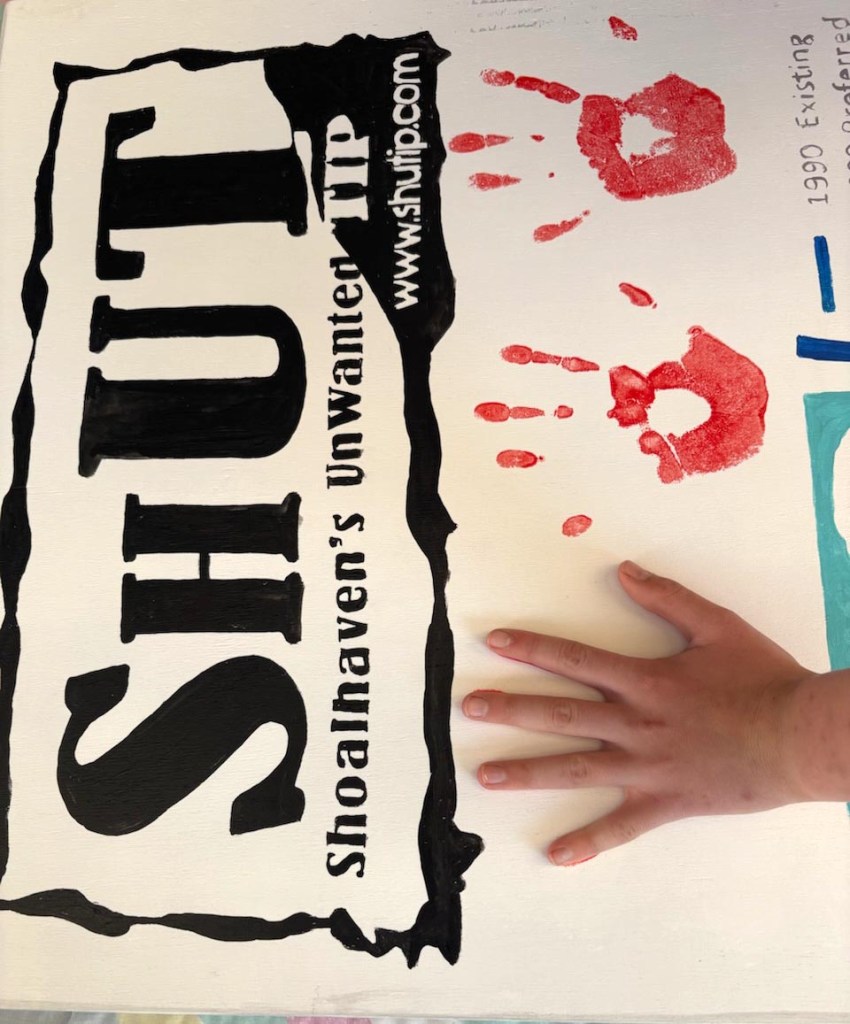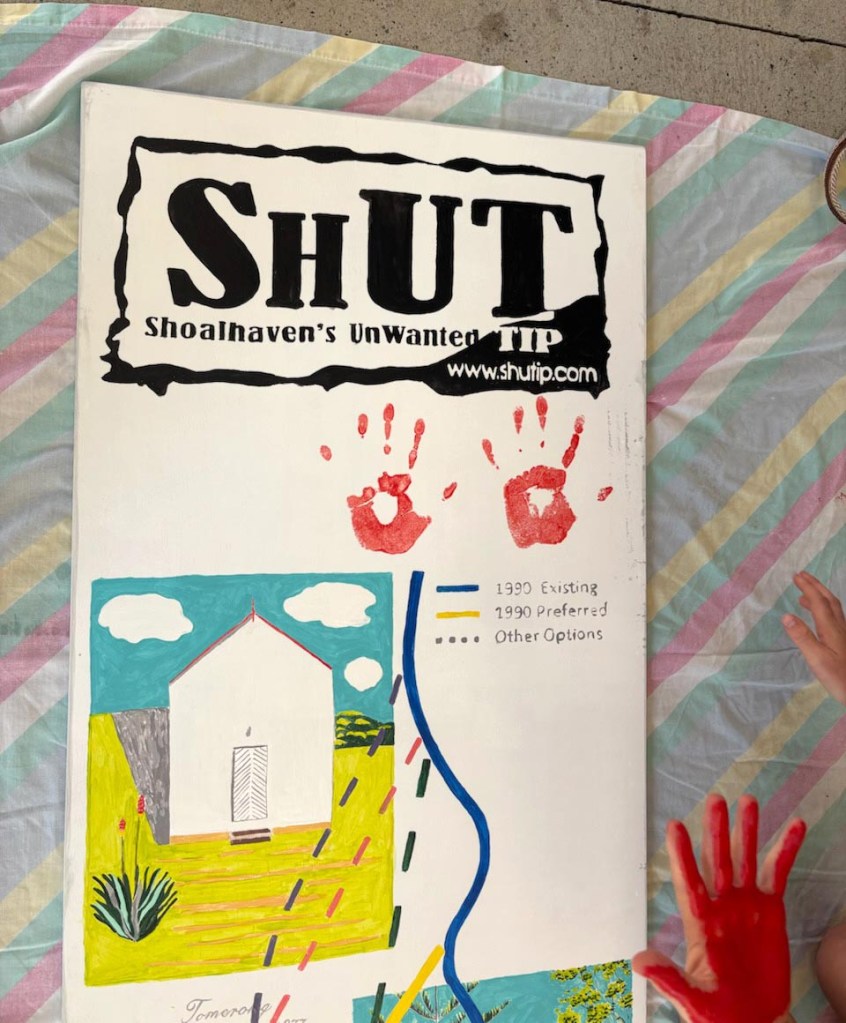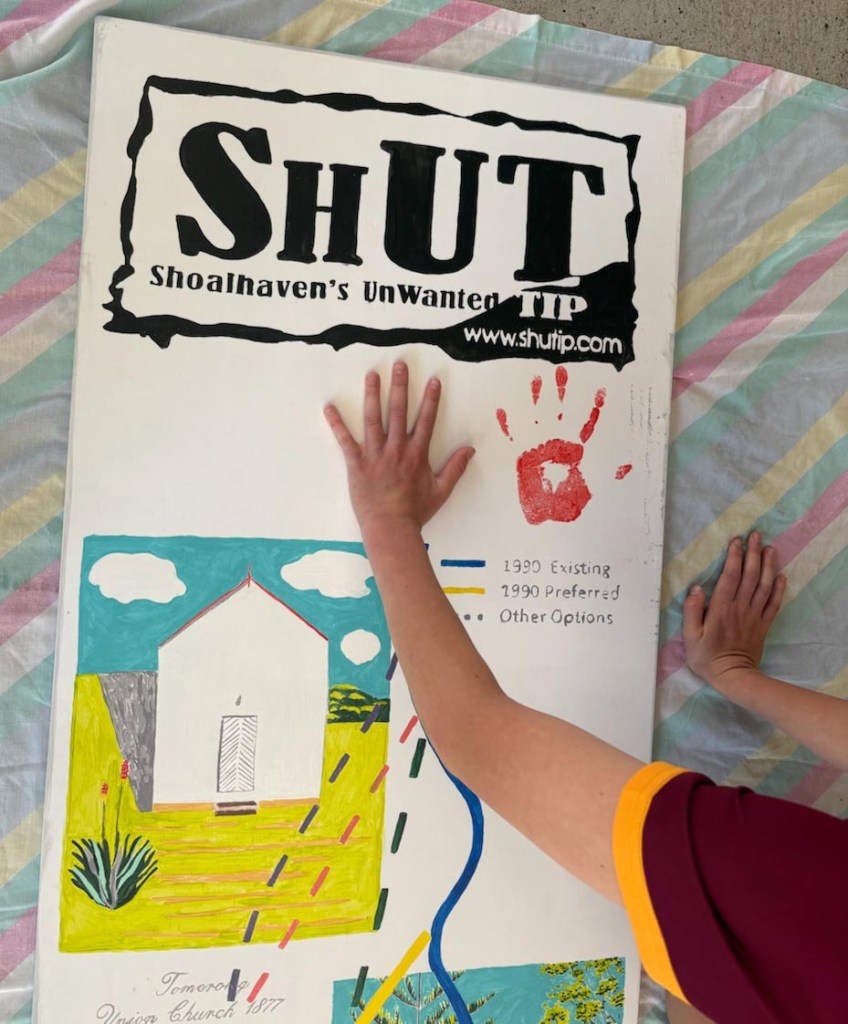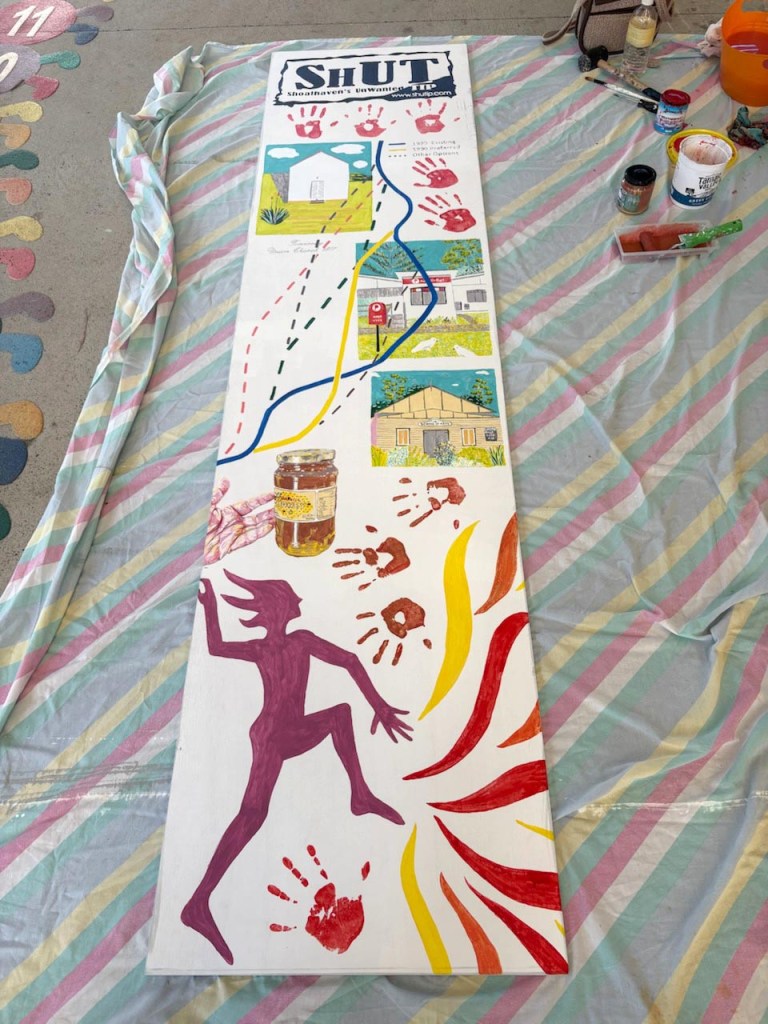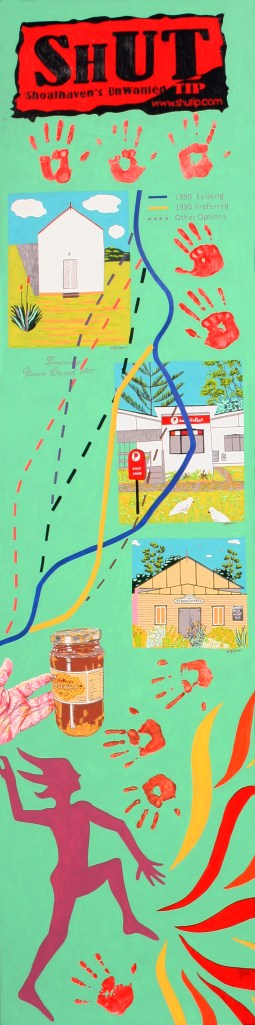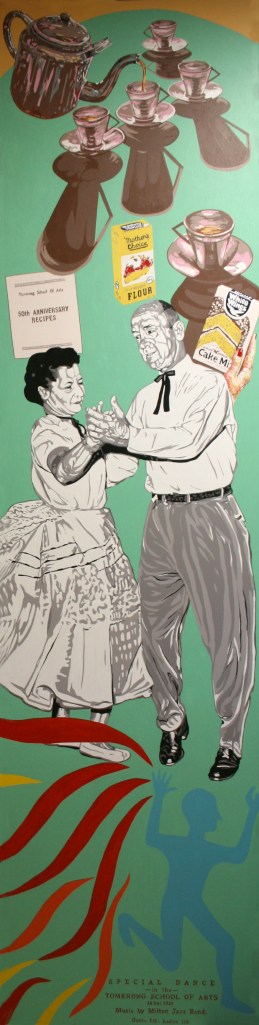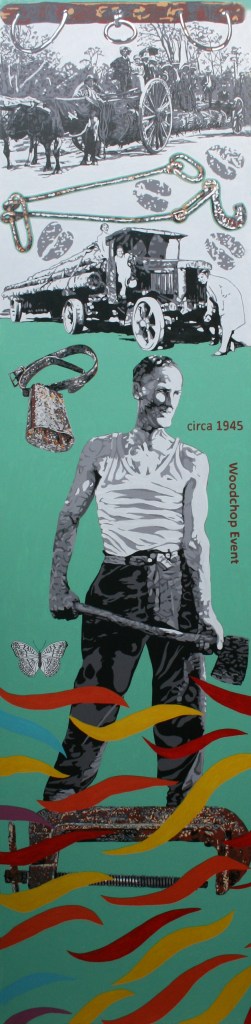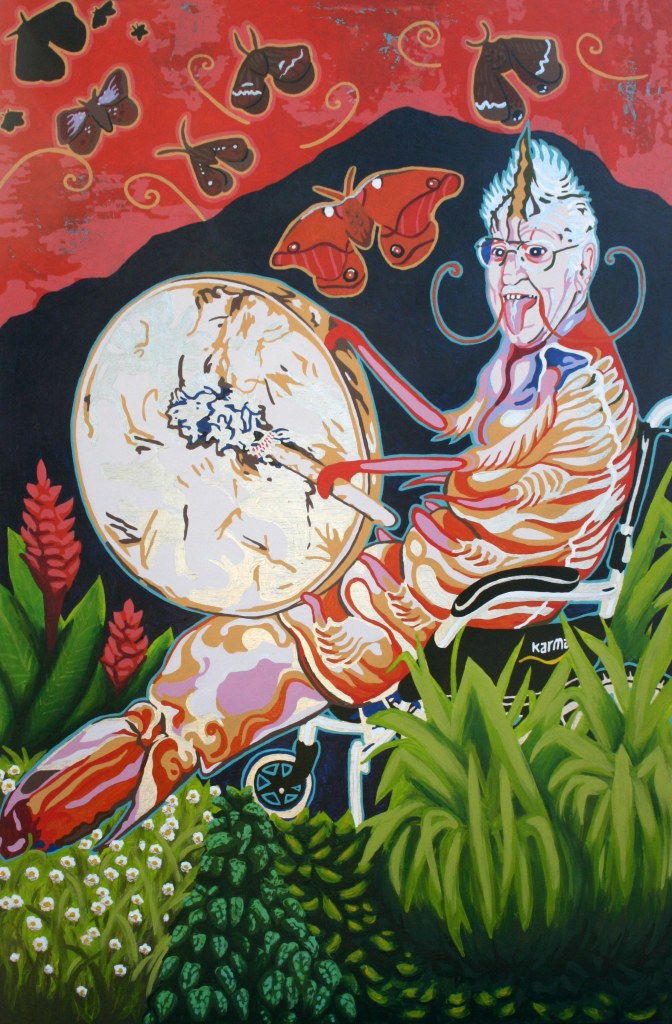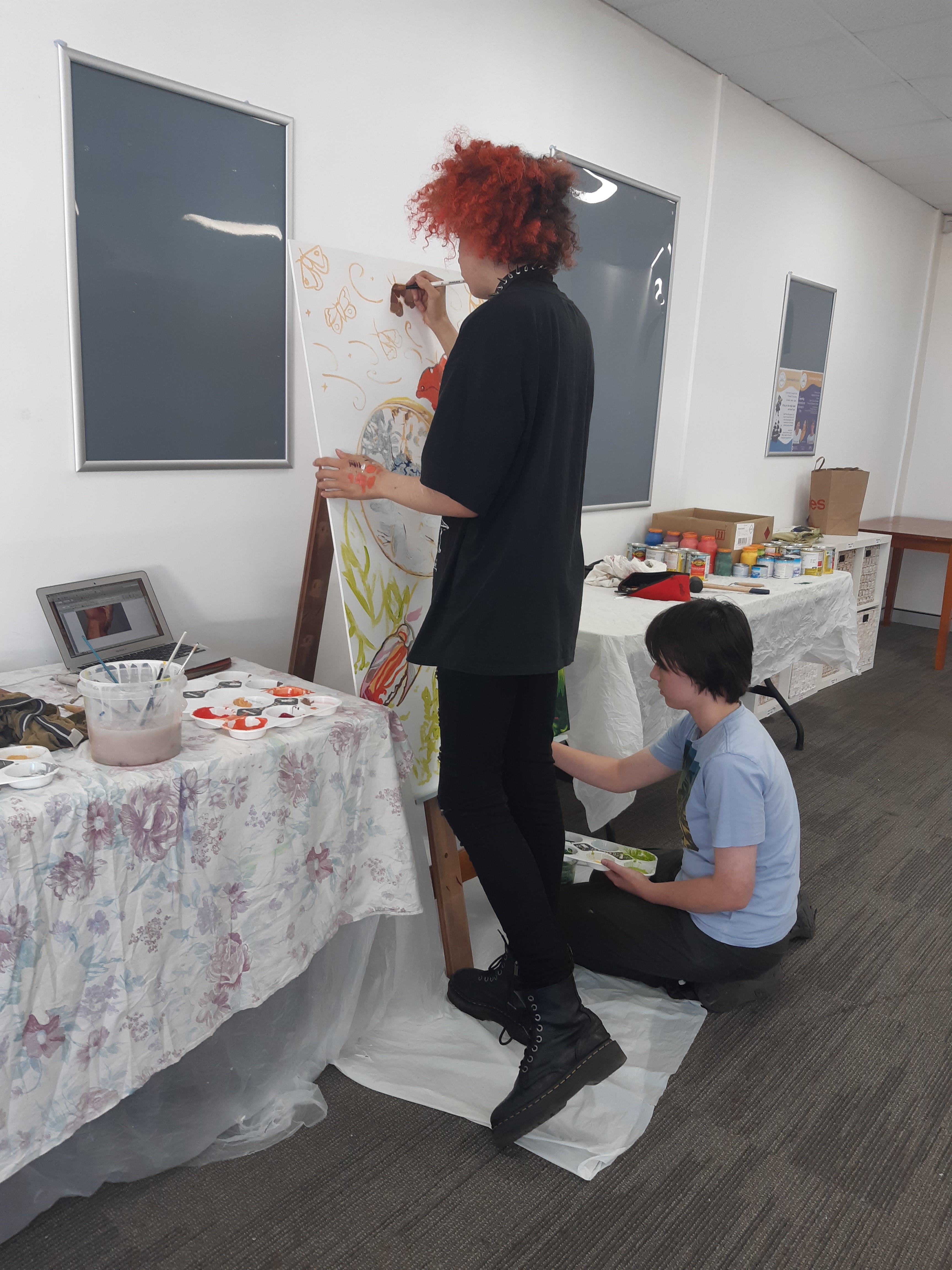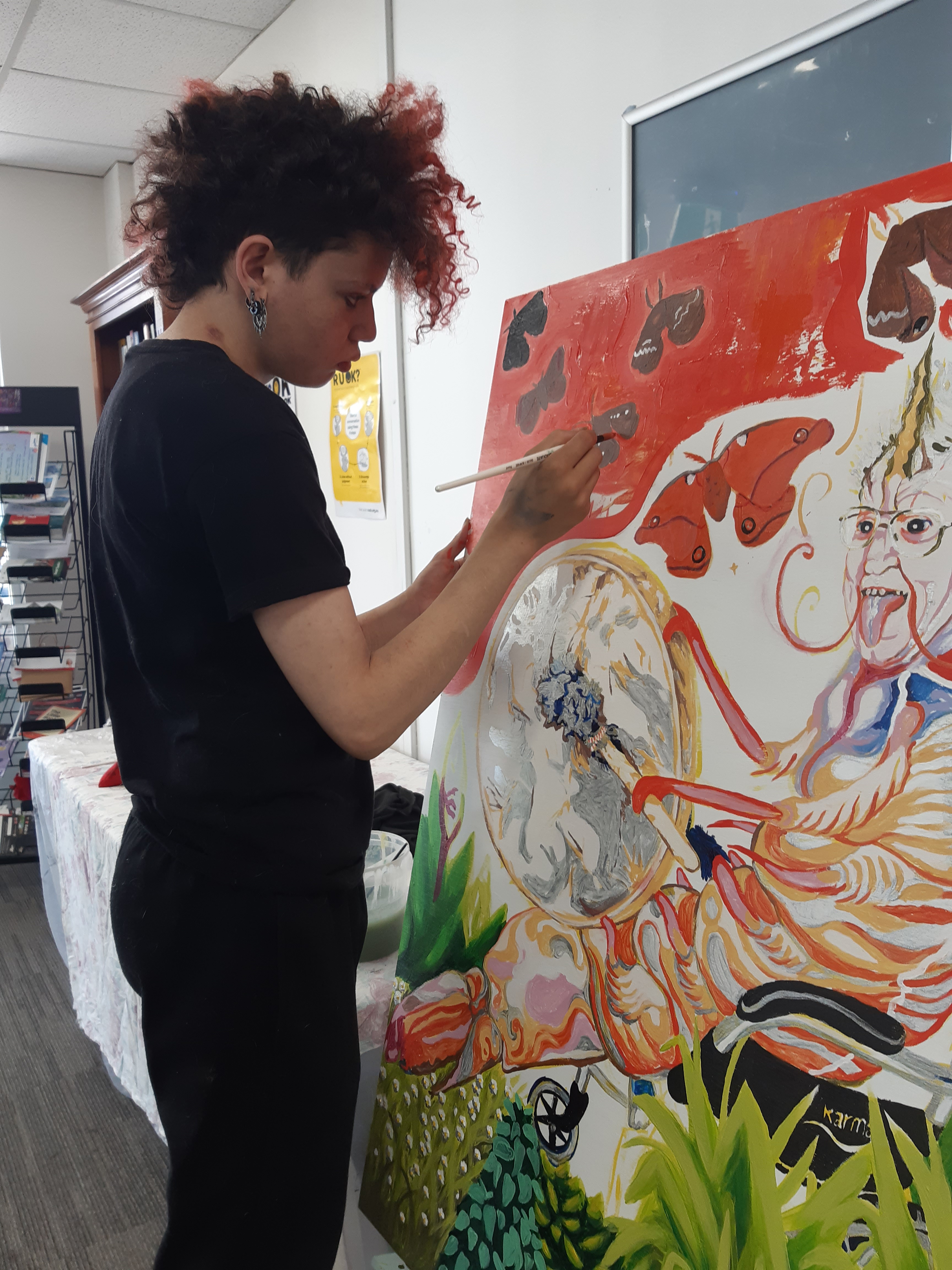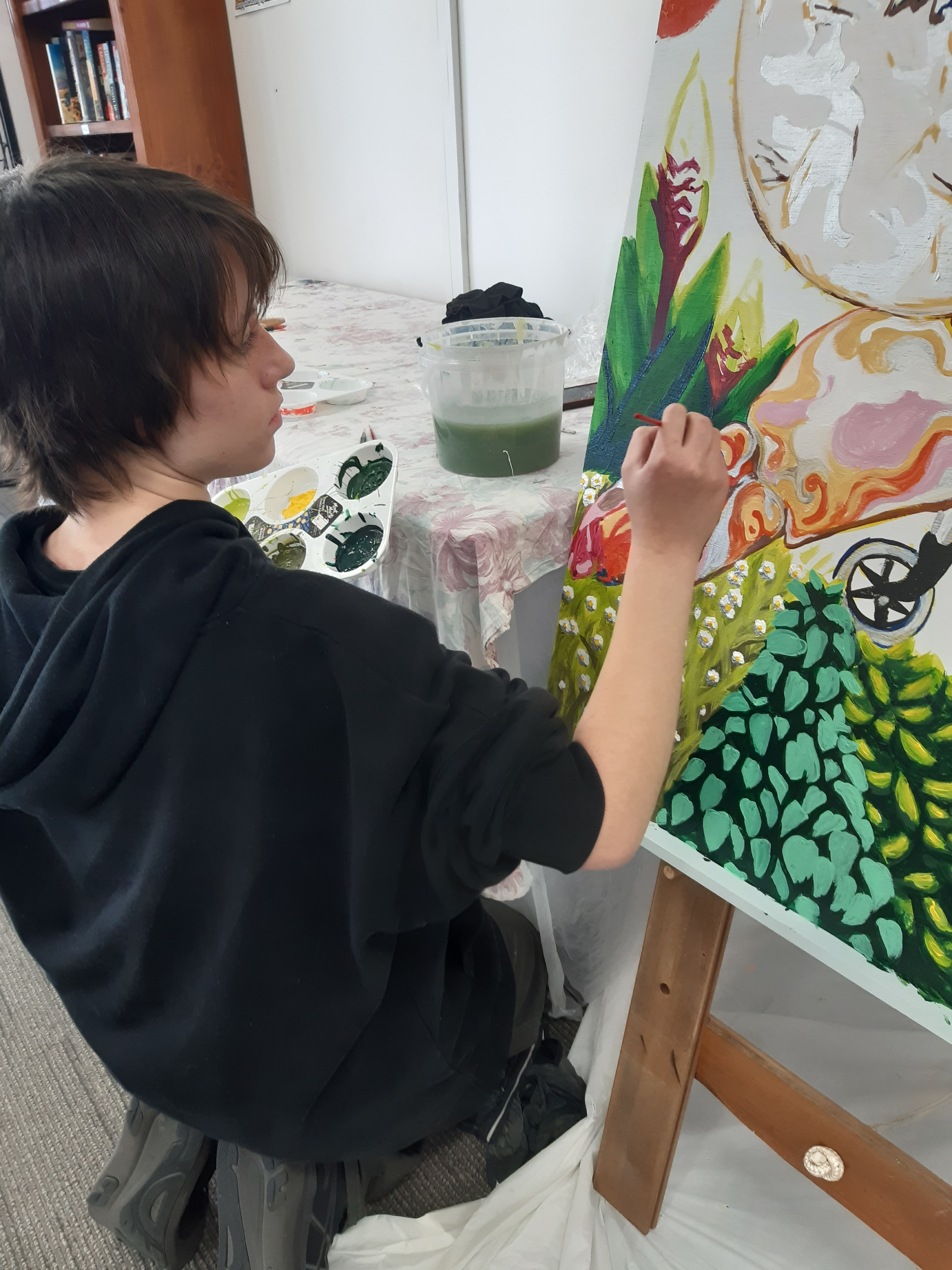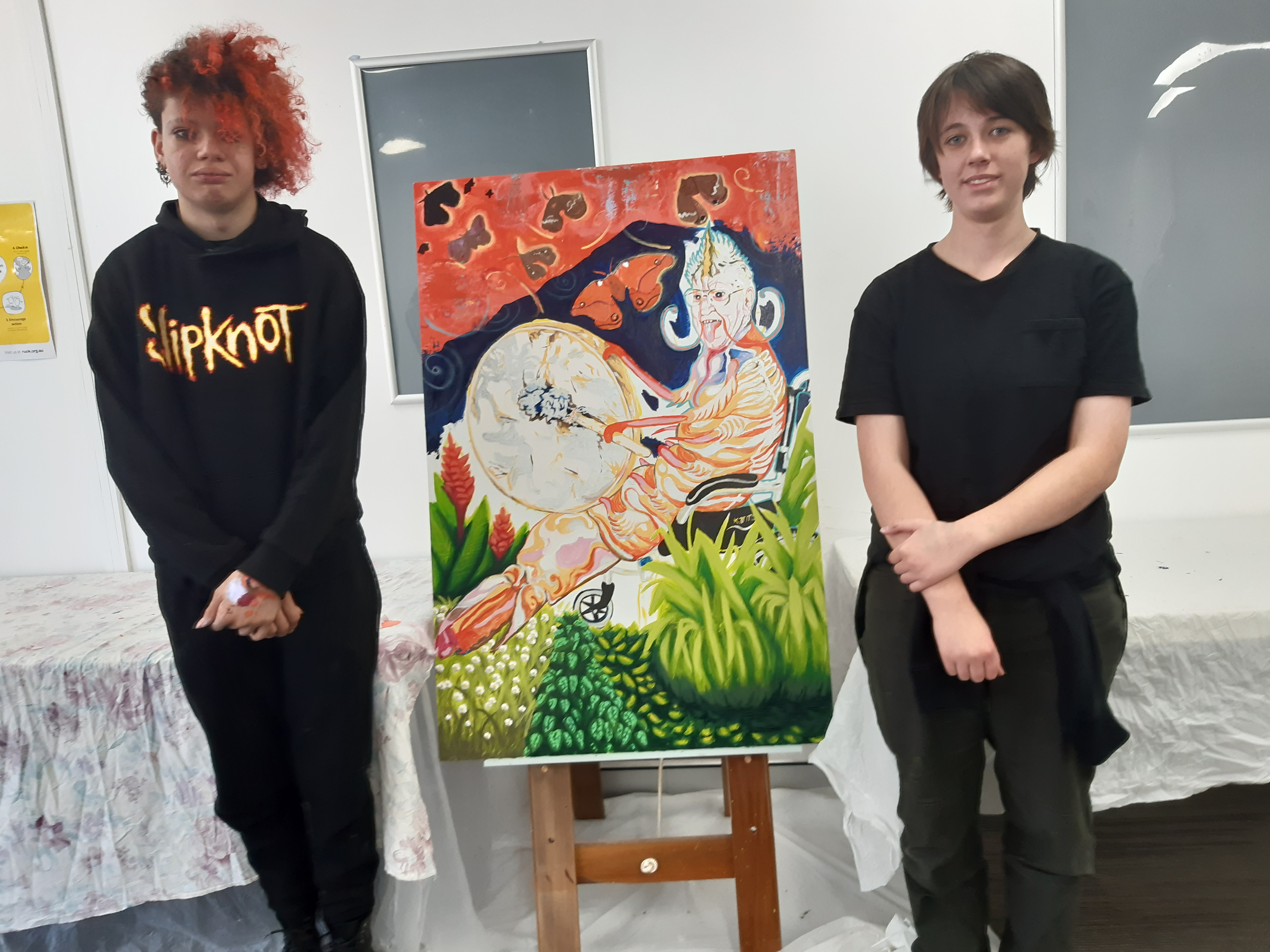
Tori Higgins, Rosemary Cochrane and I painted a mural panel for the Tea Club in Nowra as a part of the Regnite Nowra CBD Art Walk funded by NSW Government’s Uptown Accelerator Program. We painted the initial coat together in the Vincentia Connections Community Hub during the second week of the April school holidays and had lots of visits from interested community members. We even had enquiries about future mural commissions! I completed the final coats in my studio yesterday. The Cosmic Prawn character featured as the spirit of the Tea Club is a Surrealistic portrait of a local percussionist Stan, known by locals as Cosmic. Cosmic is a colourful character who has been painted by other local artists (including Bob Dixon and Helen Nugent). Consultation with original creator of the Tea Club Ross Longfield revealed Cosmic as an enthusiastic regular performer at the Tea Club when it began. Cosmic has become a fatherly figure for me as a drumming mentor since the passing of my father who taught me to play drums. Cosmic wanted to be painted in a non-serious surrealistic way to reflect his personality. Rosemary painted tea plants that feature on the menu at the Tea Club, while Tori has painted the sky, mountain and ghost moths fluttering upwards.
Cosmic Prawn – Spirit of the Tea Club 2026 Exterior House Paint on Marine Ply 81 x 122 cm The Tea Club Nowra
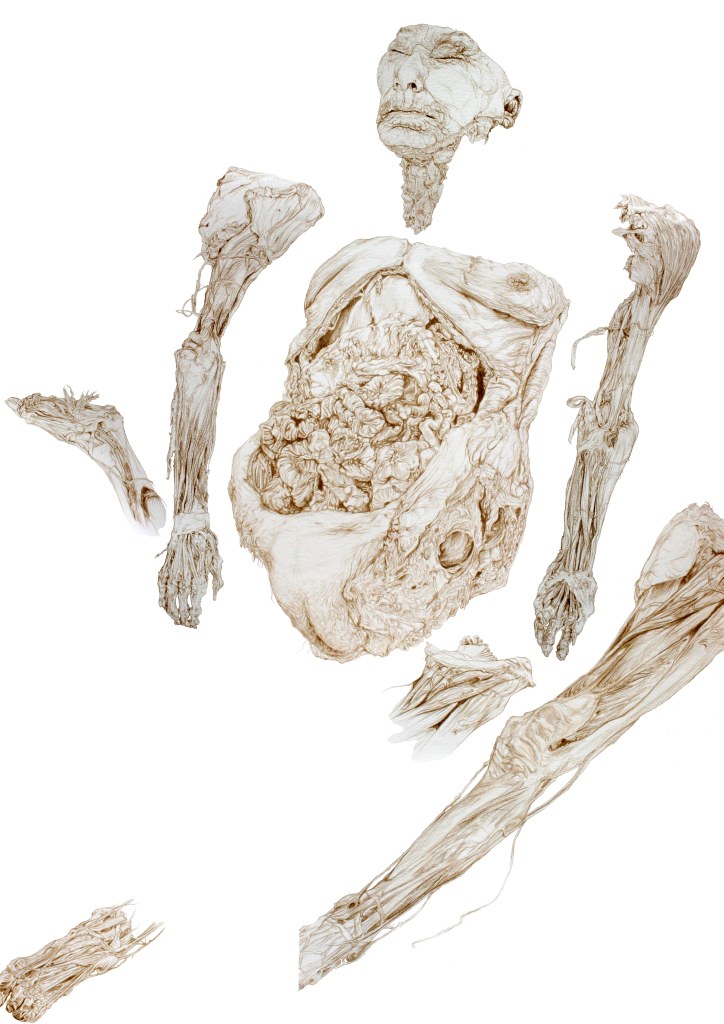
On Tuesday 21st I completed a digital collage of aquarelle drawings I had created when an artist invited other artists to the bowels of the UNSW where surgeons trained on human bodies donated to science. There was a strange humour in the department, no doubt to deal with the obvious horror of dealing with human body parts. It was expressed by a head that had been ‘carried’ around the department for a while referred to as the ‘basket case’ as two holes had been cut in either side of the skull to enable it to be carried like a basket. They began the drawing session by bringing out female body parts (one assumes from the same person) incrementally to draw starting with arms, then legs, then torso and head. I think the torso was the most confronting. My collage reflects the dismemberment and the scientific culture our bodies are subjected to. The work will be exhibited on from the 2nd – 12th July at Tiliqua Tiliqua 257 Enmore Rd, Enmore in a show called Paper, Rock, Scissors.
Human Wet Specimen 2007 UNSW 2026 Digital Collage 42 x 59.4 cm $499 unframed
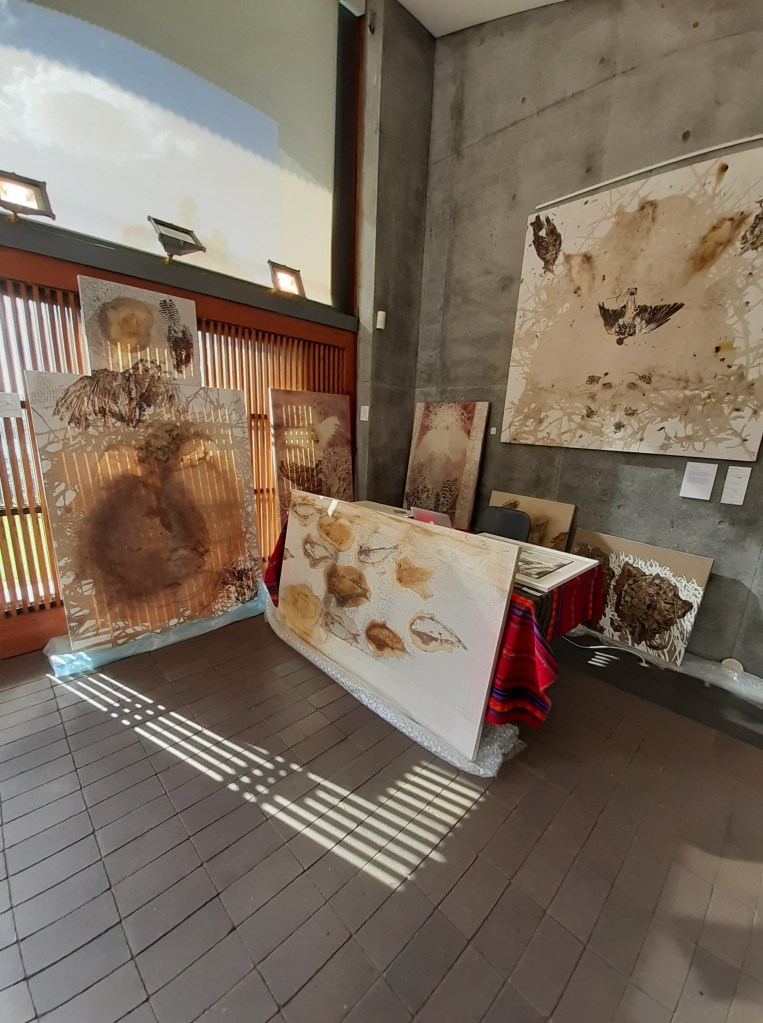
Today I participated in BAMM, which was a wonderful experience. I have Virginia Settre to thank for inviting me to participate. A wonderful array of visitors enabled me to share my unusual shroud process, which was well received. Dear old friends (Middlemost) and fellow local artists such as Anna Glynn, Natalie McDonagh and Barbara Dawson also visited. I was also surprised to meet one of my patrons, thank you so much. Thank you also to those who took the time to listen to me talk about my work and the links I make between material and meaning. As a response to the current ecological crisis animals (including the human animal) face, my work is evidence of those lives lost that I encounter as a witness. Works that were well received included Autumn Mullet 2016 – the centre piece for my marine relics hextych. I talked about the taxidermy practice of my father Tibor Barbay, whose posthumous taxidermy retrospective occurred in the very same space I was in – the Boyd Education Centre.
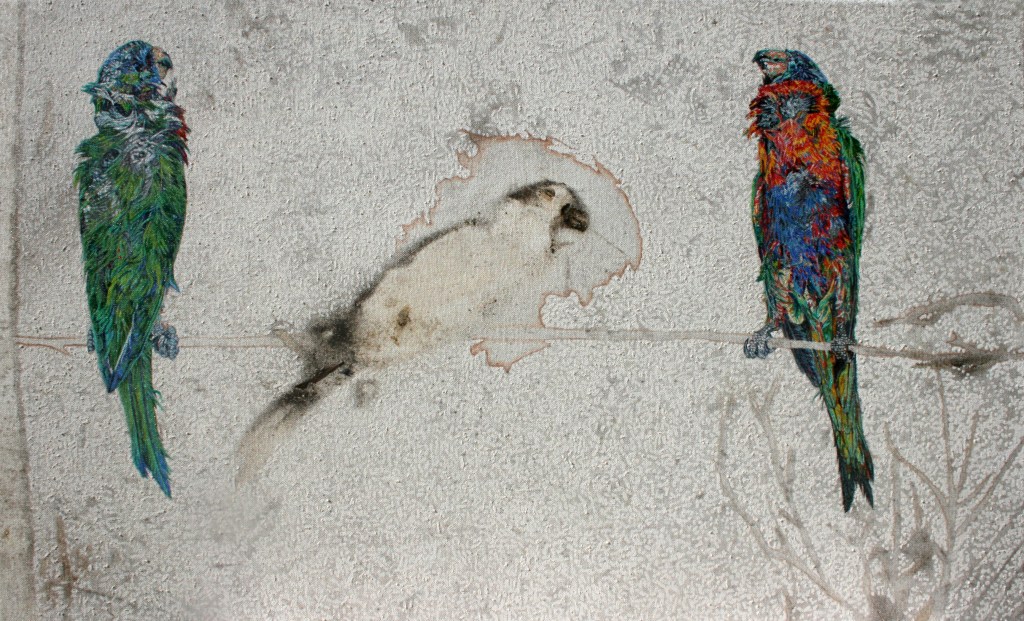
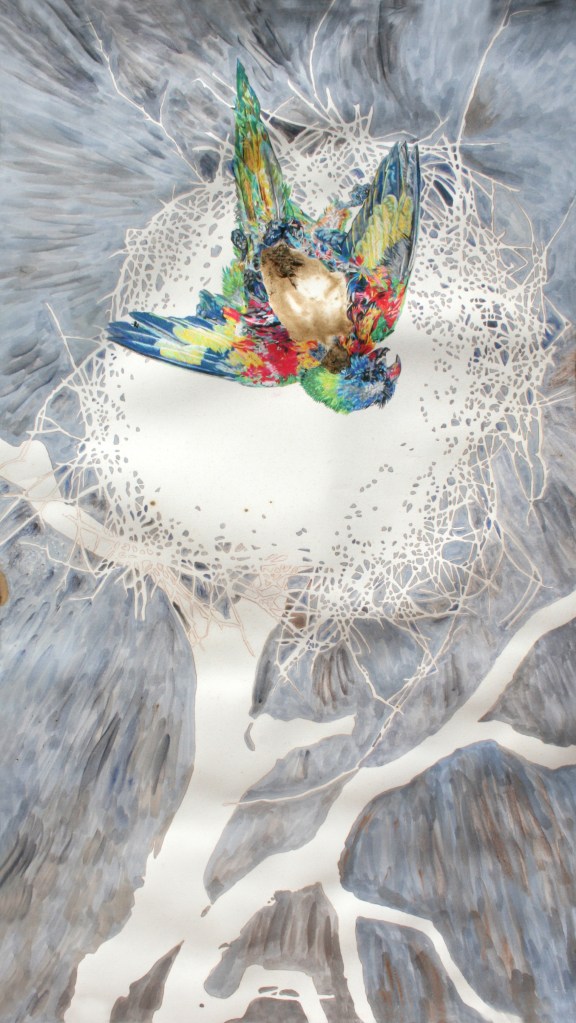
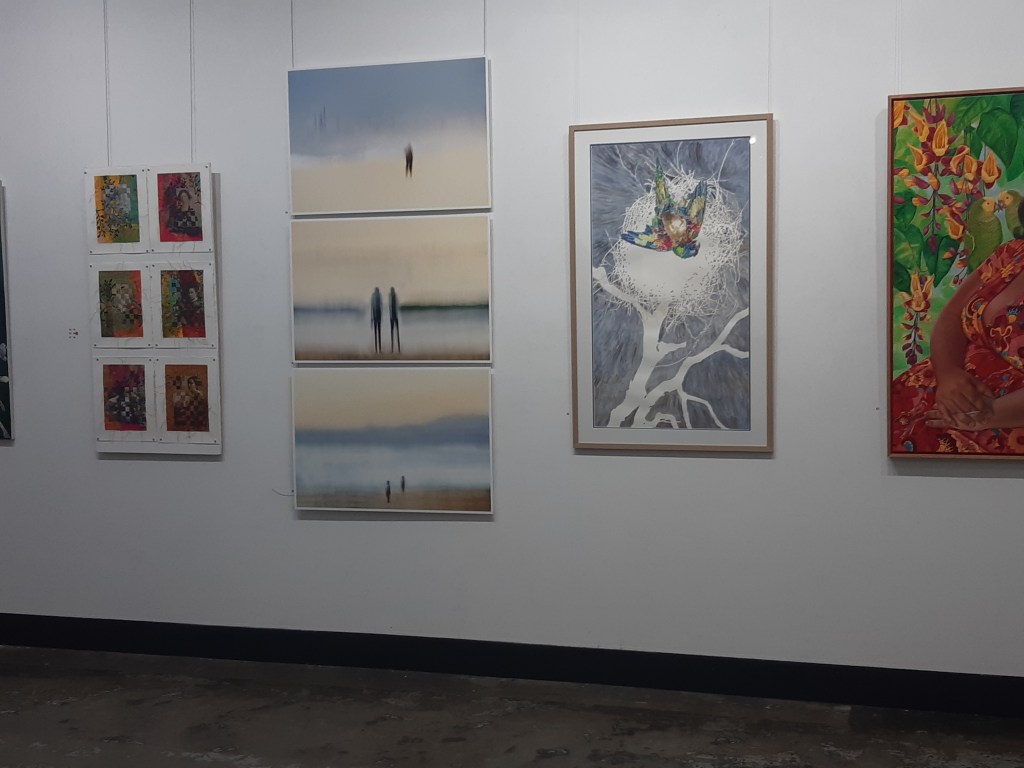
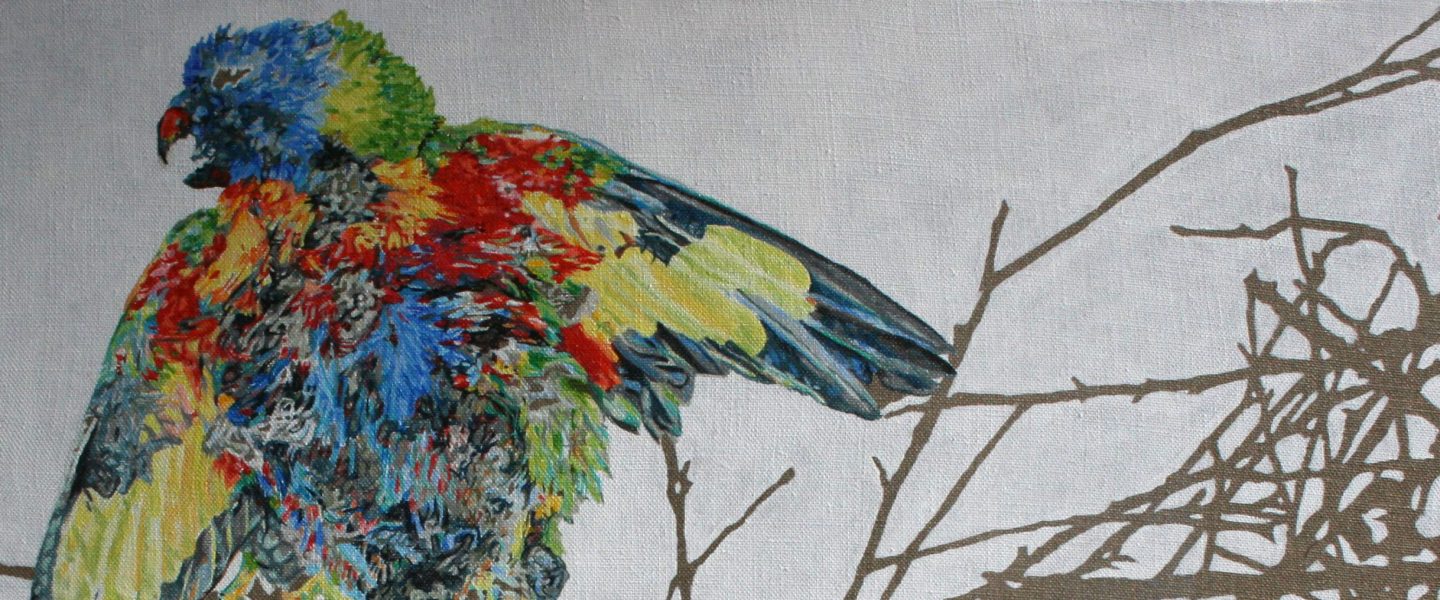
I finally completed a lorikeet shroud on paper I had created at Bundanon during my residency. It took 27 hours, the chalk pastel being particularly time consuming. The work is on show at Project Contemporary Art space for IWD from the 4th – 22nd March.
Rainbow Lorikeet (Autumn 2015 Bundanon) 2026. Pastel, watercolour and rainbow lorikeet on paper, 60 x 108 cm unframed $1840 framed
Harv is a friend and Tomerong local whom I visit regularly. He is a colourful charismatic fellow and enjoys shaping opals into pendants. One day he was showing me his opals by holding them between his large fingers in the sun to see their colours. Hence Harv becomes an opal.
Harv Becoming Opal2026 Oil on Canvas 30 x 30 cm$360
With the help of Samantha Tannous I dyed my Shagai (Mongolian divination bones) indigo and then used a dremel to inscribe the 12 planet x 12 sign = 144 symbol combinations to create my own táltos divination system. This was a system I developed in my 20s (1990s) while reading the work of Sitchin and his study of the Sumerians. At this time I extended the Tree of Life from the 10 planet system as explained by Israel Regardie based on Crowley’s work to a 12 planet system. I was also reading Joel Dobin’s explanation of Hebrew Astrology as the foundation of the old testament (12 signs = 12 tribes of Israel).
I was born when the sun was in Sagittarius (half horse/human). I would have nightmares that were just the sound of hooves running fast. My nagymama Matild Czigany (A horse gypsy of Lake Balaton who had prophetic dreams, wove carpets and tapestries, played violin and kept a goat herd), told my mother to strap me to a board as I had an extra vertebrae like my father. The doctor’s thought I had mild scoliosis due to my long curved tailbone. When I was in primary school I thought I could fly and would jump up and sit on tall fences to prove to my friends I could. I had regular flying dreams where I would lie face down and vibrate then float.
At age 7 I fell from the top bunk bashing my ribs on the corner of the dresser and crawled to my parent’s room bleeding from the wound in my side. This side pain has returned. When I was little, an African girl would smother me and give me tiny fetishes. I would bite a black one for bad luck. My Magyar father’s strange taxidermy and drumming practices enthralled me. He collected several wooden staffs, one featured a bird-like figure. He called me his shadow as I followed him everywhere watching him pin butterflies and skin animals. I would crawl in the bird pens and commune with them for hours until my mother called me. To fall asleep, I would bang my head rhythmically on my pillow until I began drumming at age 13.
As a young adult, extreme mood swings led to fits where I was consumed by the suffering of nature at the hands of humanity. At this time a man came to my door and told me I had seven angels attached to my body, he said most people have one or two. Continued flying dreams began to feature a snake-like staff that vibrated above my body to make me rise. I would always fly straight up and then fall. Before I travelled to Arnhem Land I had a prophetic dream where I flew over the stone country escarpment. I am plagued by a sense of failure (hiba). Am I a fallen one (half táltos)? Now my ankle is torn from drumming, dancing and running. I cannot walk, I am falling into hiba.
“In Hungarian traditional folk belief, táltos is a mediator between the world of the living and that of the dead, but he may have had numerous other roles in the folk belief gradually changing over the centuries. The figure of the táltos is inherited from the shamanistic worldview, however, today he only has a positive role. The táltos is characteristically born with an additional bone, for example an extra tooth or six fingers [like my young niece – also a gifted artist]. However, this fact must be kept secret. In several places it was held that not long after his birth the táltos can speak, but the parents are not at liberty to reveal it.”
“If all his unconventional characteristics are successfully kept secret, at the age of seven the ghosts come for him and torture him. At this time he falls ill, or goes hiding for three days, and gets raptured and goes into a trance. When he returns, he is able to give account of what he saw in the otherworld, where he saw the dead and was taught. The táltos has a sky-high tree and predicts the future having climbed on it. The essence of the táltos’s activity is contacting the otherworld in order to fulfil assignments to the benefit of his community. According to the legends, sometimes he hides and in the form of a bull, he fights another táltos. The fight is usually over weather, accompanied by thunderstorm, wind or hail. Thus the aim of the táltos’s struggle is to influence weather for the benefit of his own community.” (Ipolyi, 1990, pp. 14-17; Pócs, 1990, pp. 583-585; Diószegi, 1967)
According to Mircea Eliade “The Hungarian shaman (táltos) ‘could jump up in a willow tree and sit on a branch that would have been too weak for a bird’…Miraculous speed is one of the characteristics of the táltos… ‘put a reed between his legs and galloped away and was there before a man on horseback.’ All these beliefs, images, and symbols in relation to the ‘flight’, the ‘riding’, or the ‘speed’ of shamans are figurative expressions for ecstasy, that is, for mystical journeys undertaken by superhuman means and in regions inaccessible to mankind… A Hungarian táltos ‘had a stick or post before his hut and perched on the stick was a bird. He sent the bird wherever he would have to go… aggressive mania… is peculiar to… the Hungarian táltos. What is fundamental and universal is the shaman’s struggle against what we could call ‘the powers of evil’… the shaman has been able to contribute decisively to the knowledge of death. Many features of ‘funerary geography’ as well as some themes of the mythology of death, are the result of the ecstatic experiences of shamans.”
Australian Darter (Deceased Bherwerre 2019) 2025 Aquarelle, gesso, oil, bitumen, cotton & rabbit skin glue on linen 86 (h) x 89 cm $1900 framed
Today I completed this painting of an Australian Darter found by painter Jonathan Wheeldon deceased by the waters of Bherwerre (St Georges Basin) in 2019. I am exhibiting this piece in the Open Field Salon show Berry, June 13-15 and the Birds of a Feather exhibition at Culburra Beach Common August – September. In 2026, this work will be shown in Visual Reference #6 at the Wollongong City Library from the 18th April – 17th October.