
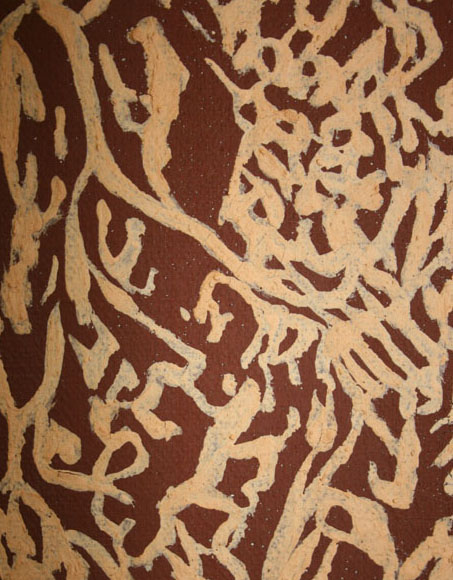
Samson and Delilah by Warwick Thornton was inspirational. I noted the positive connections to country, kinship laws and language, the humour and the negative affects of the urban environment and fossil fuels.
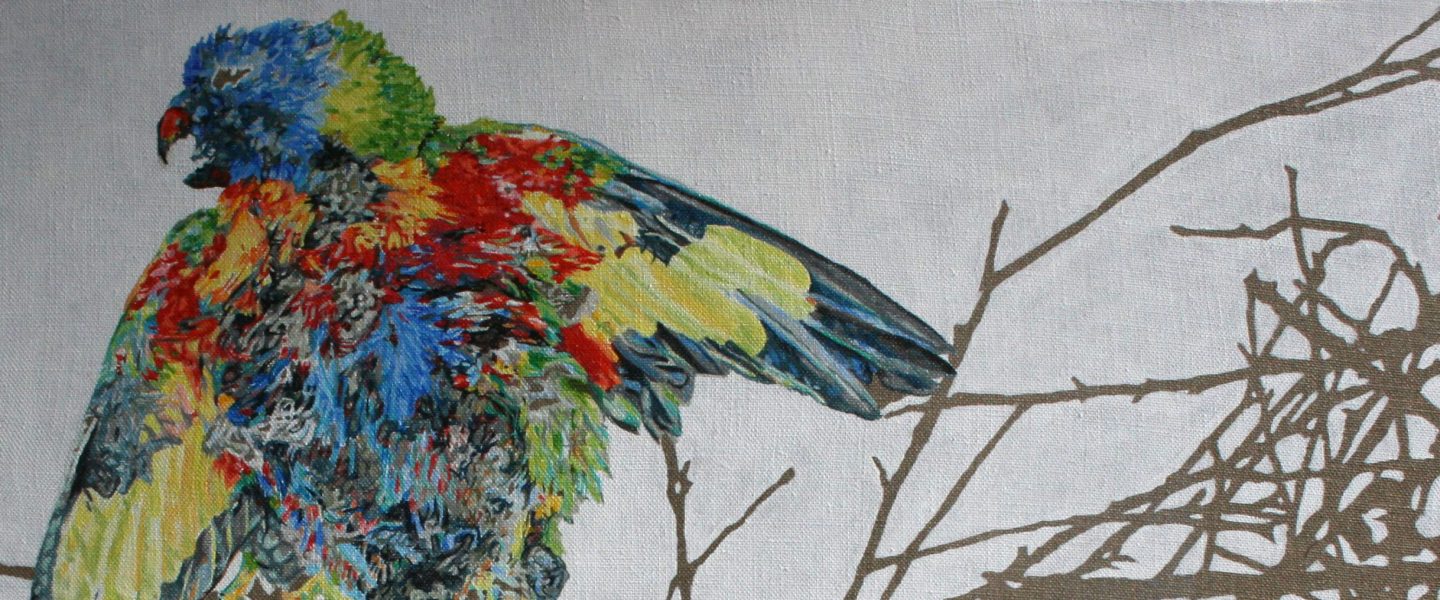
Samson and Delilah by Warwick Thornton was inspirational. I noted the positive connections to country, kinship laws and language, the humour and the negative affects of the urban environment and fossil fuels.
Deleuze and Guattari capture my imagination in A Thousand Plateaus pages 32-3,
“Let us return to the story of multiplicity…It was created precisely in order to escape the abstract opposition between the multiple and the one, to escape dialectics, to succeed in conceiving the multiple in the pure state, to cease treating it as a numerical fragment of a lost Unity or Totality…continuous multiplicities…multiplicities of distance, which are closer to the intensive…rhizomatic multiplicities…micromultiplicites…libidinal, unconscious, molecular, intensive multiplicites composed of particles that do not divide without changing in nature, and distances which do not vary without entering another multiplicity and that constantly construct and dismantle themselves in the course of their communications, as they cross over into each other…their quantities are intensities, differences in intensity.”

Met Canberra artist Frank Thirion and discussed his use of ochre and his indigenous inspired practice which connects to country and constellation.
The interest in cross cultural exchange evident in Australian art culture as indicated in the Archibald and Wynne prizes this year
The induction presentations as part of Research Fest today were very informative. Alot of advice on supervision, research management, conferences, publishing and networking. We were told to write thoughts down each morning before reading (or practical efforts) to become habitual about it as writing is the most difficult part. This writing could be in the form of small papers or exploratory essays. In addition keep an interactive plan from the beginning that evolves into a chapter outline. Read critically and always write down responses (follow practical work with evaluations too).

I was awarded participation in a group show opening on Thursday 14th May at 6:30pm at the Alliance Francaise 66 McCaughey st Turner.

Unfortunately the possum was taken by a hungry predator, probably a fox who dragged it out from under the wire.
But ranger Murray was there to provide me with another recent car fatality, a lovely female kangaroo. I had canvas just the right size, and he placed her on the canvas suggesting black plastic and wire over her. Adam helped me by covering her with a very secure plastic and wire covering. We hope she will not be disturbed. I will leave her two weeks before my first inspection. The male kangaroo shroud I created on the about page was left uncovered for a month. But as you can see below, his head had already been partially eaten.

After visiting museum websites, I became even more inspired to travel to NT and find an ochre and rock art learning adventure. Learning material processes from artists working with ochre and bark, or weaving at Oenpelli and Yirrkala art centres interests me.
Isaac Newton opticks 1704-“Between the parts of opake and clour’d bodies are many Spaces, either empty or replenish’d with Mediums of other Densities…in whose interstitial zones slender Arcs of Colours shaped almost like the Conchoid grow, violet, blue, which. bended more and more about the transparent spot are completed into Circles or Rings.”

Revealed in Light 2009 rabbit skin glue, gesso and aquarelle on canvas 120 x 120 cm SOLD
I have laid a possum killed on the road in Ainslie on canvas and placed it in a bush site for decomposition print, like the kangaroo on the about page.

