
I had the pleasure of meeting ethnographic filmmaker Kim McKenzie during May. He runs a film making course at ANU but I have known of his work since beginning my research about the life and work of Wamud Namok (Bardayal Nadjamerrek) who Kim has recorded many times on his country, at his outstation Kabulwarnamyo and as part of the Wardakken fire abatement project. I had initially inquired about footage of Madjarlngarlkum the delek site to gain further evidence that Wamud collected white pigment from there and was rewarded. I inspired Kim to find a partly edited film he had made at the request of Wamud prior to his passing to record the last Ankung djang or honey dreaming ceremony he was to conduct at the sacred honey site Djabidj Bakoluy. I was amazed this wonderful footage existed and Kim would one day publish such an important film for subsequent generations which is, I believe, of national significance. I am celebrating Wamud’s life and work at the ‘Framing Lives‘ conference held at the National Portrait Gallery and ANU from 17th-20th July. My session will be at the NPG in the terrace room 11:15-12:30.
ANU animal studies group
Since attending the ‘Animal Death’ symposium I have maintained contact with ANU PhD researcher Rhiannon Galla and also linked with another researcher, a graduate from the ANU art school Jennifer Eadie who was also at the symposium unknown to me. I serendipitously met Jennifer recently at the Cliftons award night as a fellow finalist. The circle closed when Rhiannon said she had also met Jennifer the day before and we are all meeting this week to begin an animal/human studies group at ANU. I showed Rhiannon around my studio which was encouraging after an inspired conversation about our research.
Antennae
I was surprised to find this call for submissions:
Antennae: The Journal of Nature in Visual Culture
1. Animals and Painting Special Issue
Is painting the most troubled medium in contemporary art? The death of painting has been announced with regularity at the beginning of each of the past four decades. Nevertheless, a number of artists like Gerard Richter, Lucien Freud, Francis Bacon, Jenny Saville, Peter Doig, David Hockney, Chris Ofili, June Leaf and Joseph Condo just to name a few, have demonstrated that the opposite is true through their creative reinventions of the medium’s boundaries, scope, purpose and ambitions. What role has thus far painting played in the animal revolution as experienced through the arts? What does contemporary painting has to say or do about our relationship with nature? Antennae is currently inviting submission on the topic of animals and painting for the purpose of publishing a selection of artist’s work, academic essays and interviews. Although we usually tend to focus on modern and contemporary art, this would also represent an opportunity to cover other periods.
For academics: Academic essays = maximum length 6000 words Interviews = maximum length 8000 words. Fiction = maximum length 8000 word. For artists: Submissions of portfolios are welcome but work needs to be supported by a text either written by the artist or by a reviewer/curator. Images = maximum 8 per artist. Text = maximum length 2000 words
Deadline for submissions is 1 September 2012
For more information, please contact Giovanni Aloi at antennaeproject@gmail.com
Animal Death
This Symposium held on the 12th and 13th June 2012 at the University of Sydney was nice and intimate with some brilliant presentations by some key researchers and activists in the field of animal/human studies. Of particular interest to me was Deborah Bird Rose author of ‘Wild Dog Dreaming: Love and Extinction’ and Professor of Social inclusion in the Centre for Research on Social Inclusion. She spoke of living in the shadow of animal death like “dogs crying behind the corpse house”. Her poetic approach was very evocative and her broad ranging interests, from active awareness of current crises between animals and humans, such as the flying fox colony in Sydney and Layson Albatross couples in Hawaii, to the religious existential philosophy of Lev Shestov, and the powerful art of Janet Laurence particularly ‘After Eden’. It was wonderful to listen to Janet and Barbara in conversation about the installation and her successful use of taxidermy borrowed from the Australian Museum and slowed film footage with the sound of animal breathing. The affect was enhanced by modified lights and sheer screens demonstrating the all encompassing field of installation and its ability to impress atmosphere upon the spectator. I also met sound recorder Jane Ulman who interviewed me for ABC radio ‘among animals’. I was thankful to also make contact with fellow ANU PhD researcher Rhiannon Galla from the School of Sociology. Her presentation resonated with me due to its focus on Deleuze and Bataille, a combination I have also found extremely fruitful. Rhiannon focused on ethics and says in her abstract, “This paper seeks to understand the significance of animal death from the point of view of the forces that possess us in the encounter with death. It considers how the quite literal decomposition of relations of force might expose us, not to a task that presses upon us, but to singular possibilities for new modes of life.” I anticipated showing her my shrouds.
Waterhouse Natural History Art Prize
I am happy to be a finalist again in the painting section of the art prize run by the SA Museum
I entered this work called Broken Dream finished late 2011. This painting began as a currawong shroud and I worked into the stain using the delek, garlba and gunnodjbe I collected in Arnhem Land. I also sewed into the weave using silk thread

winter shroud 2012
Adam helped me set up a large canvas under the studio eucalyptus tree on which I placed 6 mice a currawong and kookaburra. I added fresh eucalyptus leaves and some old ones and bark to encourage leeching of plant dye in evocative forms. At the last minute I added the dried magpie from the autumn shroud to encourage a clean patch of canvas in the shape of a bird. the wings of the fresh currawong and kookaburra were frozen and unstretchable and Adam suggested in future I should make an armature on which to stretch out the wings prior to freezing the body. This idea prompted by aesthetics enters a taxidermy style approach where a corpse is moved into a more live-evoking pose. I find myself uncomfortable with this as artifice enters the otherwise natural death-position of each body. Although it is equivalent to a morticians beautification of a corpse for viewing by loved ones and obviously the penetrations of wire cannot cause pain, it is a psychological discomfort I feel.
oil paintings
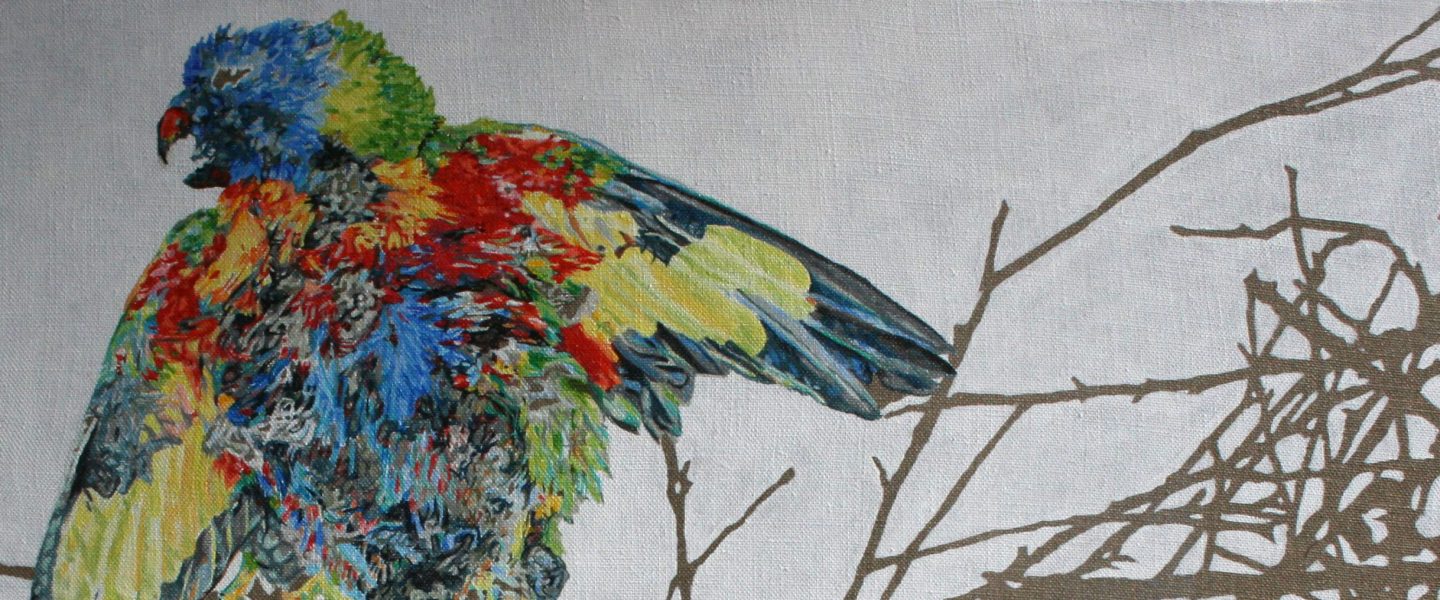
I decided to remind myself what it was like to paint in oils again prompted by the colourful feathers of a rainbow lorikeet. I had 3 sets of stretched canvas dyed in Gunbalanya and 3 dried small birds. So I began by sewing them on one canvas and painting a reversed image of the birds in oil on the other. The 3 small diptych’s look as though I have printed the birds due to the reversal enabled by using a projected image as well as the actual body.
They make evocative comparative studies to the shroud image offering different orders of representation to consider.
Cliftons Art Prize
I am a finalist in the Cliftons Art Prize entering the Winter Kangaroo 2009-11

autumn magpie at new studio site
This work began as an installation at my exhibition Dead Beauty to demonstrate the process behind the creation of the shroud image. Seeing the body of the magpie upset one lady in particular who stated that animal’s spirit was being disrespected. I wished I had the opportunity to speak to her about it as I wondered if the stretching out of his wings had been the most upsetting. When I moved the shroud installation to a new site only suitable for less abominable decompositions, such as birds and small rodents, there was another complaint due to the nearby creche and an inquisitive child. This new site is conveniently outside my studio under a majestic healthy eucalyptus tree who I hope bleeds sap generously and possums and birds defecate from regularly. This is my first shroud at this new site. I love the result and hope to build up a collection of smaller shrouds for those who prefer to see the images unstretched. I prefer the practicality of a stretched work. Maybe I could even push it with some fish and reptiles although large mammals would be out of the question as I am sure there would be louder complaints. I am yet to create a large installation site in the bush for ambitious tarpaulin works.
coastal shrouds on paper
I found a dead black snake on the way to Booderee and thought of my illustrations for Pauline McLeod about the Little Black Snake who conquers the giant goannas and becomes poisonous by stealing their poison. I placed the partly decomposed snake (nayin) on canvas to continue disintegration. I also placed shrimp leftover from my dad’s fishing trip with my kids. It would be better to stretch the paper first in my sacred waterhole.

