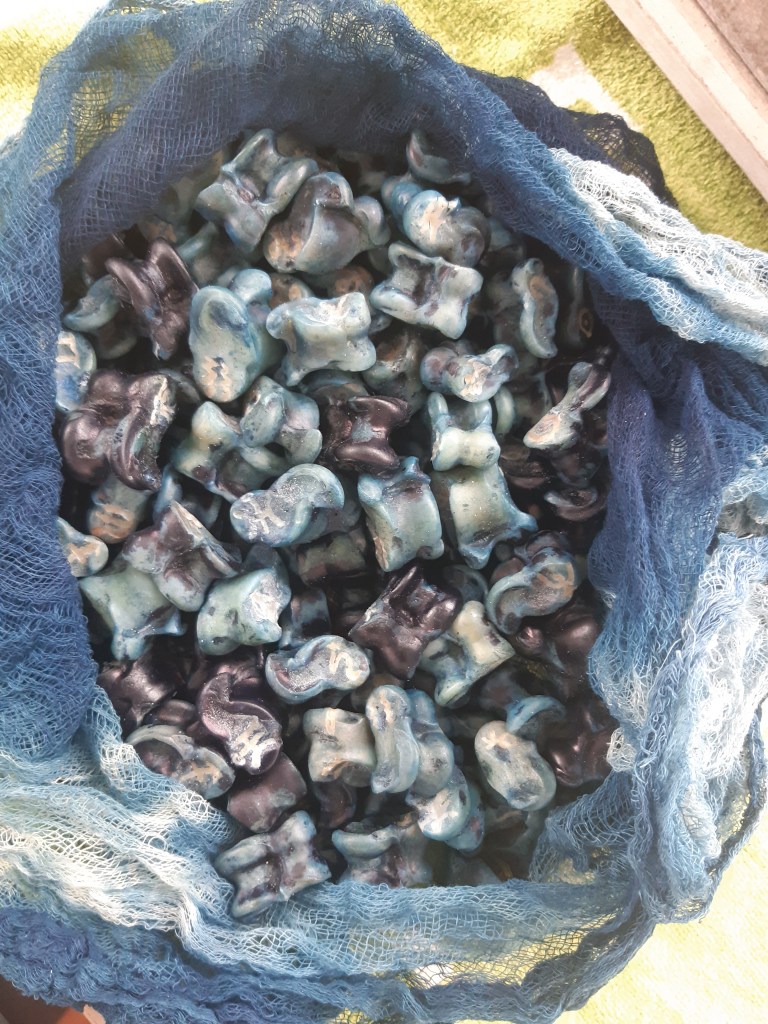
With the help of Samantha Tannous I dyed my Shagai (Mongolian divination bones) indigo and then used a dremel to inscribe the 12 planet x 12 sign = 144 symbol combinations to create my own táltos divination system. This was a system I developed in my 20s (1990s) while reading the work of Sitchin and his study of the Sumerians. At this time I extended the Tree of Life from the 10 planet system as explained by Israel Regardie based on Crowley’s work to a 12 planet system. I was also reading Joel Dobin’s explanation of Hebrew Astrology as the foundation of the old testament (12 signs = 12 tribes of Israel).
I was born when the sun was in Sagittarius (half horse/human). I would have nightmares that were just the sound of hooves running fast. My nagymama Matild Czigany (A horse gypsy of Lake Balaton who had prophetic dreams, wove carpets and tapestries, played violin and kept a goat herd), told my mother to strap me to a board as I had an extra vertebrae like my father. The doctor’s thought I had mild scoliosis due to my long curved tailbone. When I was in primary school I thought I could fly and would jump up and sit on tall fences to prove to my friends I could. I had regular flying dreams where I would lie face down and vibrate then float.
At age 7 I fell from the top bunk bashing my ribs on the corner of the dresser and crawled to my parent’s room bleeding from the wound in my side. This side pain has returned. When I was little, an African girl would smother me and give me tiny fetishes. I would bite a black one for bad luck. My Magyar father’s strange taxidermy and drumming practices enthralled me. He collected several wooden staffs, one featured a bird-like figure. He called me his shadow as I followed him everywhere watching him pin butterflies and skin animals. I would crawl in the bird pens and commune with them for hours until my mother called me. To fall asleep, I would bang my head rhythmically on my pillow until I began drumming at age 13.
As a young adult, extreme mood swings led to fits where I was consumed by the suffering of nature at the hands of humanity. At this time a man came to my door and told me I had seven angels attached to my body, he said most people have one or two. Continued flying dreams began to feature a snake-like staff that vibrated above my body to make me rise. I would always fly straight up and then fall. Before I travelled to Arnhem Land I had a prophetic dream where I flew over the stone country escarpment. I am plagued by a sense of failure (hiba). Am I a fallen one (half táltos)? Now my ankle is torn from drumming, dancing and running. I cannot walk, I am falling into hiba.
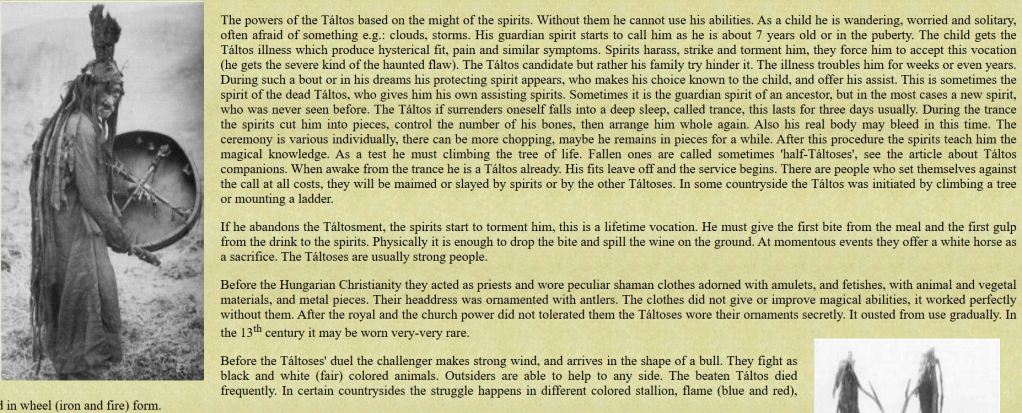
“In Hungarian traditional folk belief, táltos is a mediator between the world of the living and that of the dead, but he may have had numerous other roles in the folk belief gradually changing over the centuries. The figure of the táltos is inherited from the shamanistic worldview, however, today he only has a positive role. The táltos is characteristically born with an additional bone, for example an extra tooth or six fingers [like my young niece – also a gifted artist]. However, this fact must be kept secret. In several places it was held that not long after his birth the táltos can speak, but the parents are not at liberty to reveal it.”
“If all his unconventional characteristics are successfully kept secret, at the age of seven the ghosts come for him and torture him. At this time he falls ill, or goes hiding for three days, and gets raptured and goes into a trance. When he returns, he is able to give account of what he saw in the otherworld, where he saw the dead and was taught. The táltos has a sky-high tree and predicts the future having climbed on it. The essence of the táltos’s activity is contacting the otherworld in order to fulfil assignments to the benefit of his community. According to the legends, sometimes he hides and in the form of a bull, he fights another táltos. The fight is usually over weather, accompanied by thunderstorm, wind or hail. Thus the aim of the táltos’s struggle is to influence weather for the benefit of his own community.” (Ipolyi, 1990, pp. 14-17; Pócs, 1990, pp. 583-585; Diószegi, 1967)
According to Mircea Eliade “The Hungarian shaman (táltos) ‘could jump up in a willow tree and sit on a branch that would have been too weak for a bird’…Miraculous speed is one of the characteristics of the táltos… ‘put a reed between his legs and galloped away and was there before a man on horseback.’ All these beliefs, images, and symbols in relation to the ‘flight’, the ‘riding’, or the ‘speed’ of shamans are figurative expressions for ecstasy, that is, for mystical journeys undertaken by superhuman means and in regions inaccessible to mankind… A Hungarian táltos ‘had a stick or post before his hut and perched on the stick was a bird. He sent the bird wherever he would have to go… aggressive mania… is peculiar to… the Hungarian táltos. What is fundamental and universal is the shaman’s struggle against what we could call ‘the powers of evil’… the shaman has been able to contribute decisively to the knowledge of death. Many features of ‘funerary geography’ as well as some themes of the mythology of death, are the result of the ecstatic experiences of shamans.”
I completed my Archibald Prize entry today, although it was unsuccessful in being selected twice (I also tried the Portia Geach Award) I believe this is because of the spiritual nature of the work. I depicted my childhood friend and local Aboriginal elder Theresa Ardler using collected ochre pigments, including the pipeclay gifted to me by the late Laddie Timbery, which I used to paint traditional dots around her eyes. The red is terrestrial, and represents the blood of Ancestral women and Theresa’s experience of blood loss (she has experienced her own death). The gold is visceral and rich like emu fat and expresses the wealth culture holds in the heart, while the black charcoal is cerebral and swirls like nebula or ethereal thoughts. I added a touch of gold oil paint on her gold earring. Initially we had spoken about adding possum pelts leftover from her completed and in-progress budbilli (possum skin cloaks). I used tracing paper to draw shapes and cut some out of the pelt. But when I lay it the soft fur in position, I thought it detracted from the ochre painting. The original shroud was a mother and baby possum from summer 2015, which called to me and Theresa in my studio as she shared her loss of baby Marley Jessie George Ardler. The mother possum stains evoke her cloak and the baby stains eerily become the body of her baby seated on her knee. Since painting Theresa, her spiritual path has led to a momentous encounter. She was the last person to meet with Pope Frances in Rome before he passed away.
Possum Pietà 2024, collected earth pigments, charcoal, gold oil paint, aquarelle, rabbit skin glue, mother and baby possum (summer 2015) on canvas. 98 cm x 115cm. $2260
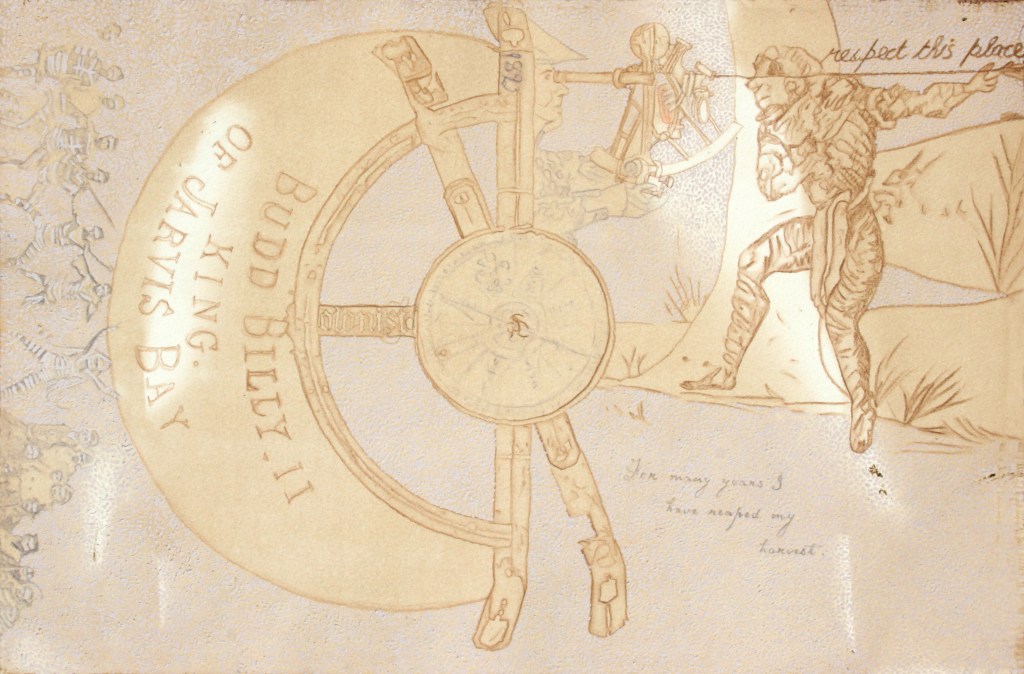
Respect This Place (After Uncle Laddie) 2022. Pipe clay, wattle gum, sap, aquarelle and billabong on paper. 37 x 55 cm unframed SOLD
The selection of materials for ‘Respect This Place (After Uncle Laddie)’ 2022 communicate my personal response to the Halloran collection (HC). As a local woman growing up in Vincentia, like my mother before me, I have a deep sense of belonging to this place shared with Aboriginal friends and mentors. A significant mentor, Uncle Laddie, gifted me the pipeclay featured in this artwork and his words and handwriting ‘respect this place’ inspired the work and feature on an object in JBMM. This work pays tribute to Laddie’s lifelong work as a cross-cultural teacher and activist based at JBMM.
The paper support was soaked and stained c.10 years ago in the billabong near my childhood home. It is a place frequented by both my mother and her brothers and my siblings and I as children. I feel the presence of my ancestral spirits here. My grandparents, Keith and Gloria Sheehy purchased land from Warren Halloran in c.1955 across from the creek that feeds this billabong. The HC features maps recording Warren’s ownership and sale of the land that created Vincentia village. I chose to represent the instruments of nautical navigation and terrestrial surveying in the HC, as they are symbols of the colonisation and subsequent land sales in Vincentia.
In the Shoalhaven, colonisation began with Alexander Berry pictured in ‘Respect This Place’ using his sextant from the HC. His body merges with the graphometer to become the instrument of colonisation. His words ‘For many years I have reaped my harvest’ also feature in JBMM. Opposing Berry is a stylised representation of an Aboriginal hunter inscribed on a whale tooth from the HC. Cupping the graphometer on the left is a drawing of the breast plate worn by ‘Budd Billy’, who also featured in the JBMM photograph of a local corroboree pictured.
I was inspired by the idea that Artist Run Initiatives should be paying their artists to exhibit/perform rather than artists paying to exhibit/perform.
In the SeeChange Festival 2018 I have an installation in the Sandholme Salon Show 2 Jervis Street Huskisson Open daily – 10am to 4 pm 26 May 2018 to 11 June 2018. The installation is part of a larger ongoing project produced by Jenny Robertson titled ‘Shared Pathways – The Wool Road Project’ assisted by a grant from the Shoalhaven Arts Board. This video organised by Jenny and recorded by Michael Buckley and Susan McCauley will be on display as well as relics from the original Vincentia Post Office, an oral history recording of my mum Maree and uncle David (equipment and editing generously provided by Brad Slaughter BBCR Shed), Photographs of my grandparents Keith and Gloria Sheehy at the Holden Street General Store early 1960s and mum and David at the original building 2018.
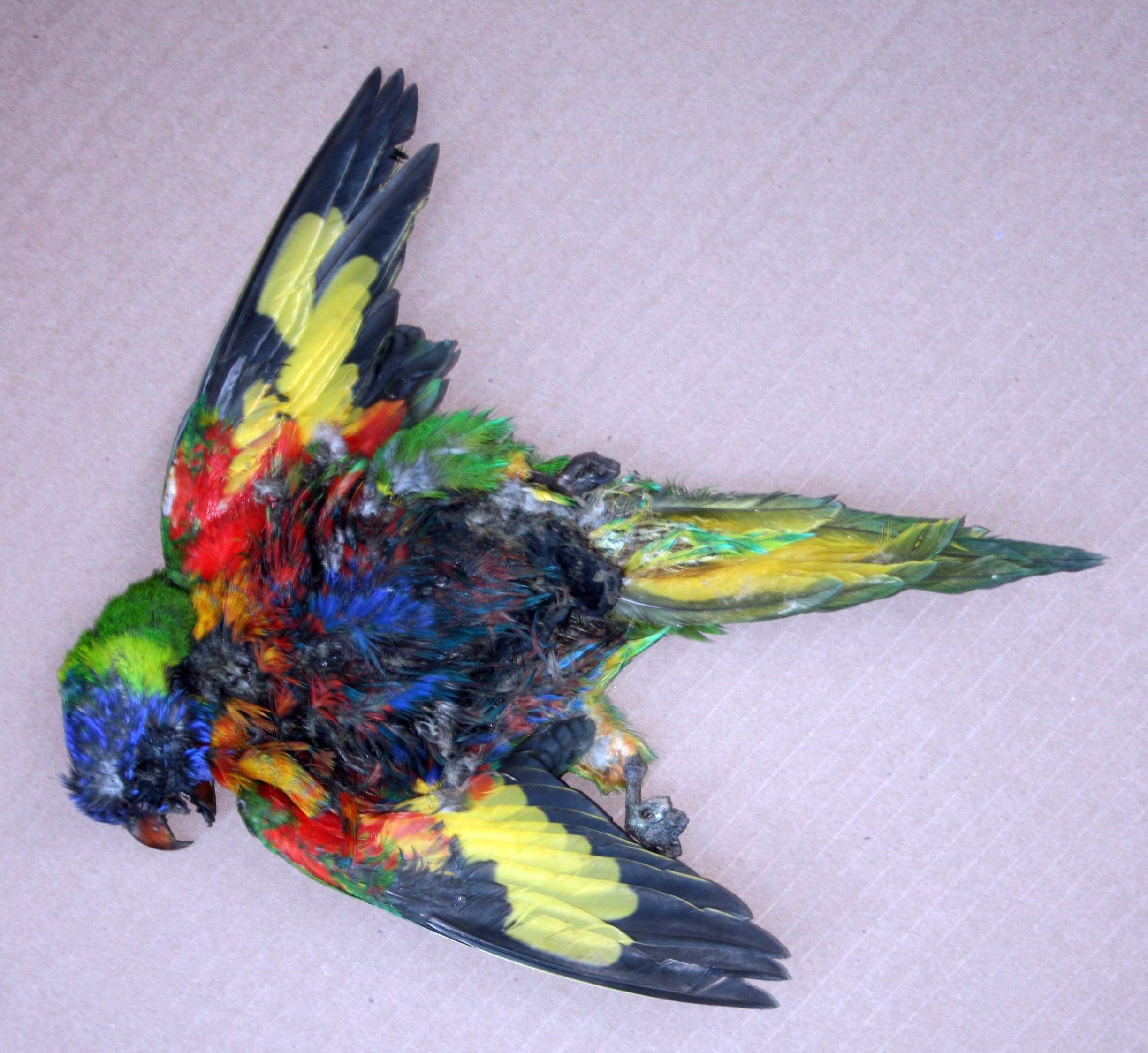
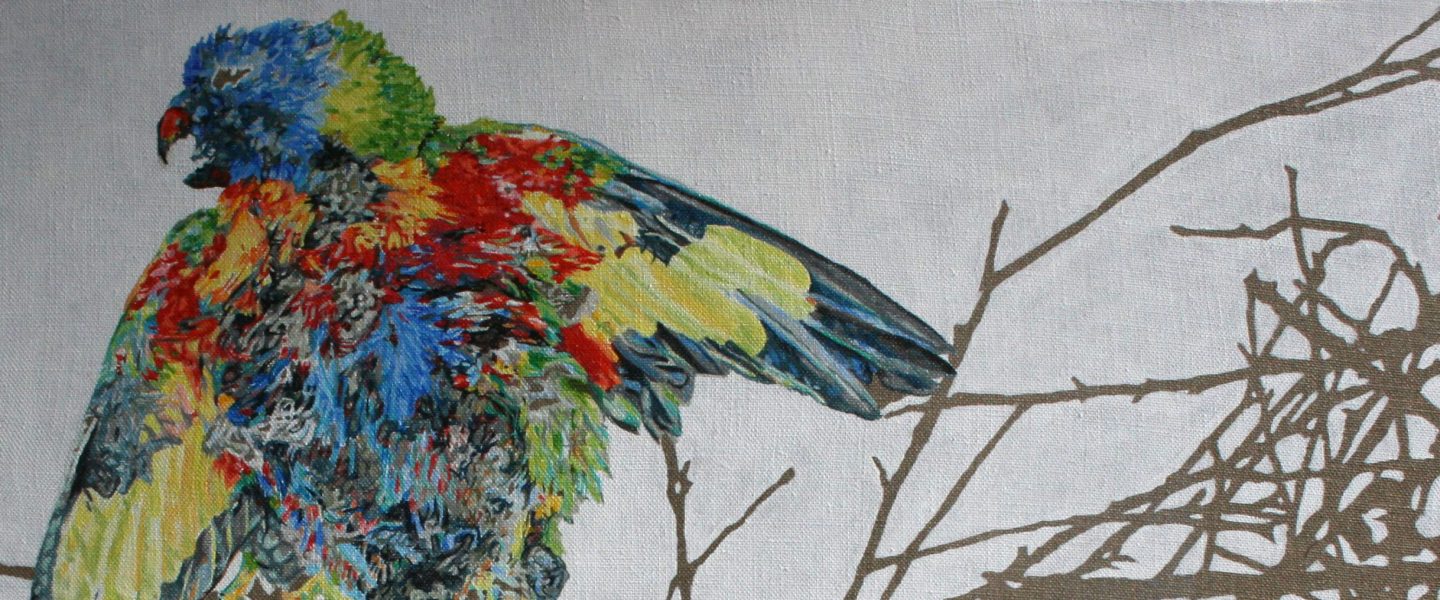
On Sunday I completed the Rainbow Lorikeet I had created at Worrowing during my residency. The Lorikeet was found deceased by Alicia Talbot during my residency at Bundanon in 2015. Its shroud on paper is still waiting for a watercolour painting. At Worrowing I had a strong desire to paint on a sturdy linen stretcher with rich oil colours. I remembered a friend (my former primary school teacher) Bruce Malbon had requested a colourful bird, so I felt inspired. I began the ‘paint’-staking but enjoyable process of completing two coats of gesso in the negative space between the nest motif consisting of the raw linen glistening with rabbit-skin glue. I also left raw linen sections inside the Lorikeet too, which made the oil painting a little more challenging. I am very happy with the result.
Bundanon Rainbow Lorikeet 2017 68(w) x 64(h) cm SOLD
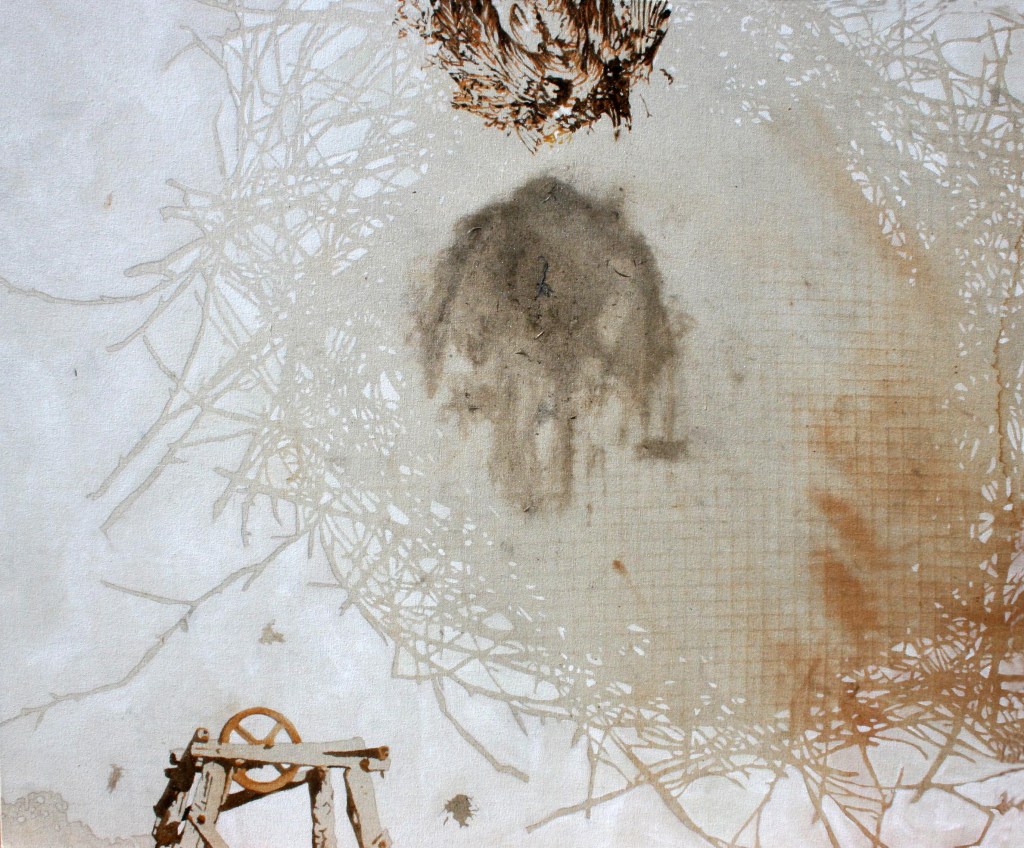
During my PhD I created many ‘shrouds’ using an installation set up on a farm in the Monaro where Tony and his partner the sculptor Steven Holland live. The crested pigeon was found deceased on a road in Canberra and placed on a sprung bed-base to decompose. The eucalypt under which the canvas lay leached its rich brown bark juice on the right hand side while the mesh protecting the body from predators left a rusty imprint. Originally exhibited without further work undertaken as Alone (Spring Pigeon) 2011 in my graduate show, I was suddenly compelled to take the work to Hill End with me in 2016. It was there I added my most common motif, the nest using delek the sacred white ochre from Madjarlngarlkum in Western Arnhem Land. The nest is a cosy home offered to the bird and myself when away from home. I then painted in the post-decomposed body of the pigeon using bitumen and a touch of oils that speak to the bark stain. I lined the bird beaks up like a reflection, a conversation between two forms of representation; one created by the disintegrating subject another the painted signifier. I then located the work in Hill End by painting in an iconic structure found in the town using a very minimal technique in which the main body of the figure consists of the raw canvas ground sized with rabbit skin glue which sparkles under lights and seals the bodily fluids and debris to the surface.
Alone (Spring Pigeon) 2011 in Hill End Winter 2016 Crested pigeon, delek, bitumen, oil and rabbit skin glue on canvas SOLD
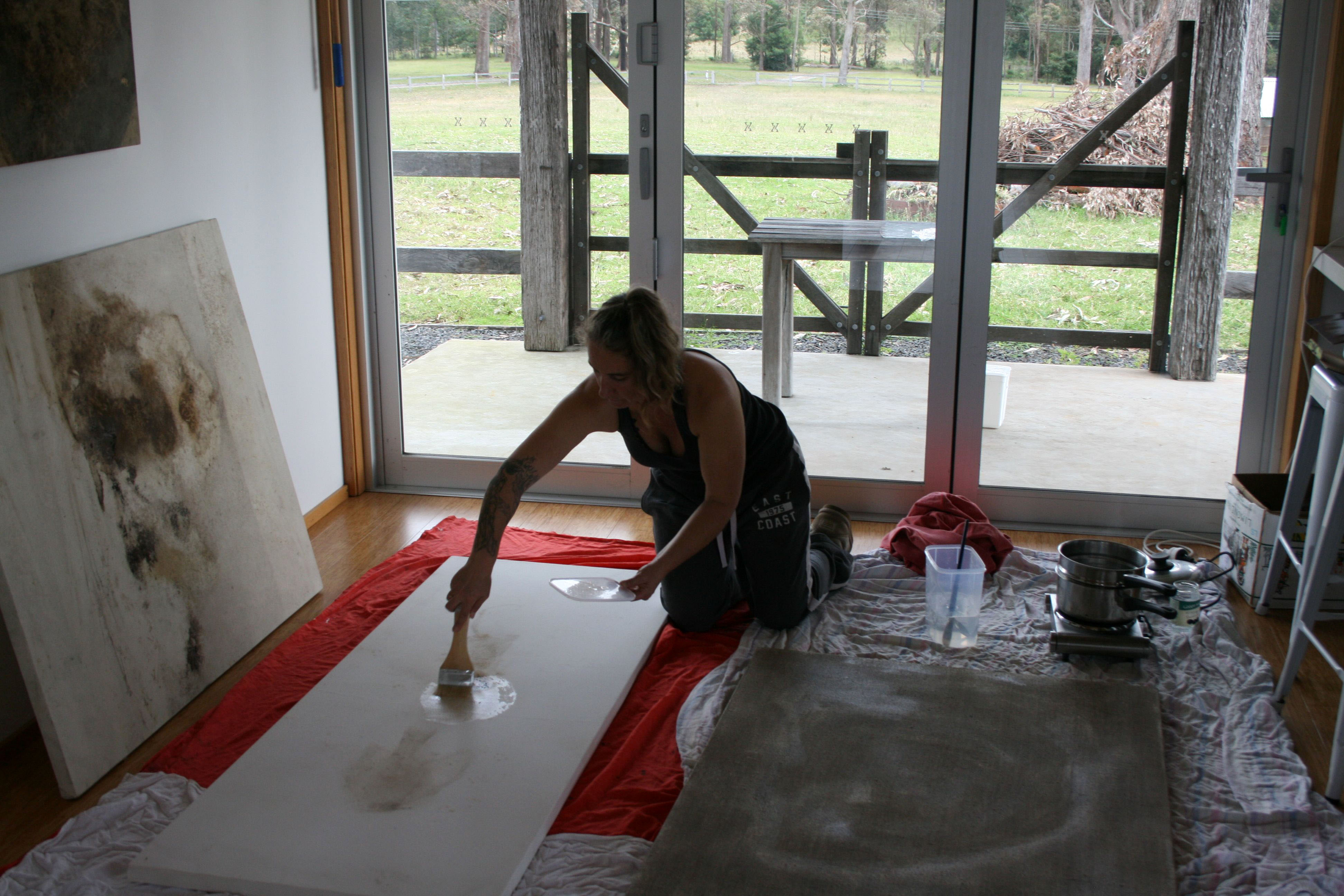
Waking up seeing the colours of dawn from bed and painting. I had soaked a batch of rabbit skin glue and alum to size a bunch of new linen and canvas stretchers, one being the ringtail and magpie shroud created at hill End. I worked on Bherwerre 6 more too and thought of a work to paint for the Flourish theme Ravenswood Art Prize, although I only have two days left to create it, which may be impossible. Darren and I walked down to the dams and swamp on the property and found some clay colours suitable for the ochre expedition on Sunday. I was hoping to also find wattle glue but there were mainly casuarinas, eucalypts and paperbarks.














 Laomedia