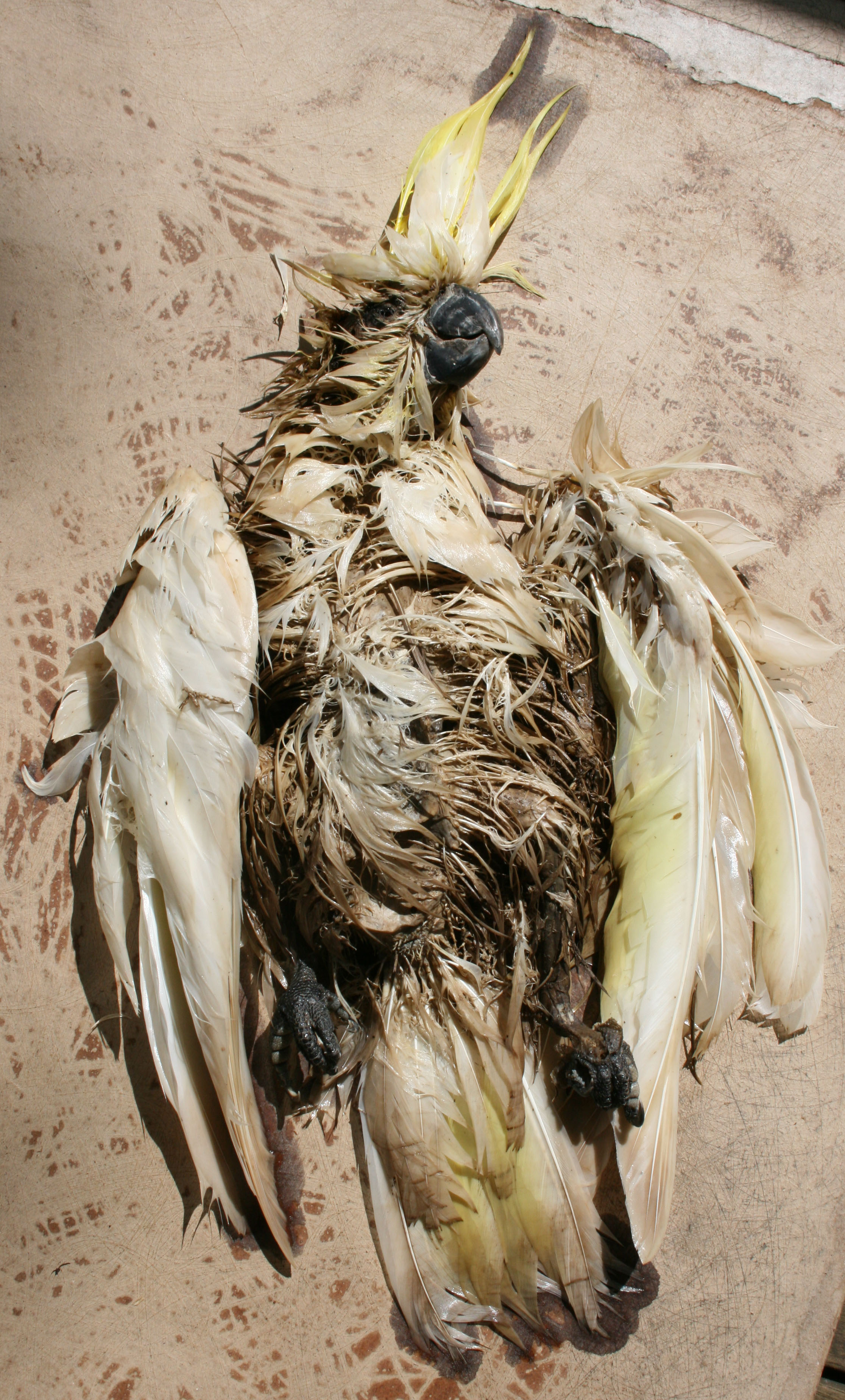
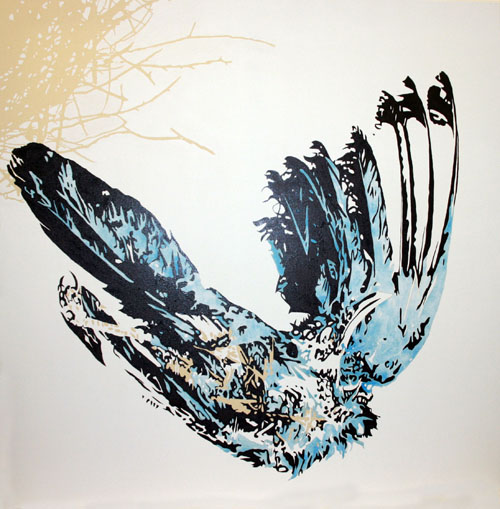
On the same day I saw and collected one dried and one fresh white cockatoo body. The white feathers and yellow crest matching the delek pigments collected in Maburrinj. I placed the fresh bird in the freezer, and placed the dried one in metho. The latter had the sweeter smell of the drier stages of decomposition. Its body cavity is exposed, especially at the back, but its front, with its skeletal face and full crest in tact are what I wish to paint in my current work featuring the currawong.
I am currently working on the Currawong shroud from January 2010 (refer to post). I began surrounding the stain with a nest created by painting delek in the negative space between the woven sticks. I stopped midway thinking I would like to define the currawong shape in a subtle way using silken thread stitches. I had been inspired last year by the brightness of silken thread amidst naturally dyed thread in the Indonesian/Malaysian tapestry on exhibition at the NGA. The result was more than I had hoped for, while being delicate and fine, as expressing care and refinement, an illusion was created of another plane. This was due to the assumption the shape was stitched on. The process of stitching is very intensive, the piercing of cloth ground at times smooth through a ready opening in the weave, or difficult when blocked by tightly woven threads. I thought of explanations of central Australian sand painting in Balgo in Piercing the Ground by Christine Watson, which I am currently reading, and also of my time as a tattooist. The woven body covering akin to skin.
This exhibition is not to be missed, a rare and valuable opportunity to see the dolobbo (bark) and djurra bim (paper paintings) produced by a painter who also produced kunwarrde bim (rock paintings) in the ancient way. His family were proud and informative at the opening, his grandchildren having produced a mural painting featuring his most familiar motifs in honour of his rock painting, bringing its familial significance to the city of Sydney.
In the studio I am now equipped with supplies of ochre from around Australia, shrouds produced last summer featuring birds and rabbits (treated with vinegar, dyed in eucalyptus, stretched and sealed with rabbit skin glue), and images of the placement of bodies before and after the decomposition process and a projector.
In the absence of a body, but the presence of a mark that embodies the presence of absence, I observe images of the full and desiccated body in a picture of light that communicates with the elusive tonal indicators present on a dank woven burial cloth. I fall into fascination with those indefinite stains, and resist further reconstruction of an internal presence.
In the first instance a particularly nebulous collection of fluid defies any visual recognition, so I introduce the silhouette simultaneously aware of the wire-mesh grid that also imprinted its dirt and rust stains inconsistently over the weave. I work from the projection of the whole body beneath the mesh using delek, the pure sacred shit of ngalyod, whiter than the whitest gesso. I define the in-between space of the mesh, as though the body is backlit and elevated in an alluvial substance. The body appears simultaneously arrested and freed, in motion and static, pure and defiled. The warping grid of mesh now replicates in the eye vibrating an after image that plays with any stains actually visible.
In the second instance a duel shroud offers, in part, some clearly defined limbs, stomach juices, even the suggestion of an eye, and I am held in the almost and slide predictably into the conversation between the light body and stain body. The results fall short of my expectations, there is a loss of curiosity and the compulsion to inquire, so I remove the evidence of my hand after playing minimally with the second bunny stain. Exploring the ochres from my own country (Yuin) I combine an orange-red with a yellow and draw the vertical mesh lines within the body only. It follows then the top bunny should contain the horizontal alternative.
My supervisor Nigel Lendon alerted me to the existence of a burial platform replica across from my studio by the lake in front of Old Canberra House. It was a collaborative project to which Nigel contributed his skill in construction. It is attributed to Djon Mundine/Fiona Foley who initiated the concept and use kangaroo bones as a metaphor for human remains. It is titled Ngaraka: Shrine for the Lost Koori 2001 and mirrors my own yearnings for this type of burial practice in which the body and its decomposition play a major part in the mourning process. It could be said that the natural disintegration of the body following death defines the active and public period of mourning. A sense of closure is then physically experienced with the second burial when the bones are collected, in the north of Australia painted with red ochre, and ceremonially placed in a log coffin or rock crevice.
In my current painting process I have partly replicated this treatment of the dead by collecting recently deceased animals and placing them on a makeshift burial platform that uses spring based bed frames. This process was developed in order to collect bodily pigments on canvas creating a shroud. I am considering collecting the bones from the next set of shrouds, which I produce over the summer period.
As my practice-based painting research has become engaged in the procuring of pigments, the written components of my thesis should reflect the experiencing of matter using its own kind of physical resonance. In this semiotic realm, Julia Kristeva’s Revolution in Poetic Language 1974 and its exploration by Kelly Oliver in Ethics, Politics, and Difference in Julia Kristeva’s Writing provide insights into writing as practice.
What approaches are available or possible in writing about material process or analyzing material culture? It is clear that psychoanalytical overtones are always present in exegetic text but need not be explicit, poetic license being therefore invited to allow the “textual presence” particular to a “writing subject” liberty. Leon S. Roudiez elucidates Kristeva’s dialectical notion concerning the nature of a text for the purpose of “textual analysis” in the introduction to Revolution,
The text that is analyzed is actually the effect of the dialectical interplay between semiotic and symbolic dispositions. Here it would be helpful to keep in mind the etymology of the word and think of it as a texture, a “disposition or connection of threads filaments, or other slender bodies, interwoven” (Webster 2). The analogy stops there, however, for the text cannot be thought of as a finished, permanent piece of cloth; it is in a perpetual state of flux as different readers intervene, as their knowledge deepens, and as history moves on. The nature of the “threads” thus interwoven will determine the presence or absence of poetic language. Those that are spun by drives and are woven within the semiotic disposition make up what Kristeva has defined as a genotext; they are actualized in poetic language. Those that issue from societal, cultural, syntactical, and other grammatical constraints constitute the phenotext; they ensure communication. Seldom, however, does one encounter the one without the other…it is often the physical, material aspect of language (certain combinations of letters, certain sounds – regardless of the meaning of words in which they occur) that signals the presence of a genotext.
Finding words that fulfill their role as communicators of matter in its sensual entirety or in addition indirectly relay unutterable (or peripheral) physical or psychological experiences is one challenge (genotext). Conceiving of the structural context in which such words can emerge while enabling understanding is another challenge (phenotext).
In reflecting on the former task, I am tempted to state my dissatisfaction with the English language regarding its combinations of letters and sounds. I have found Magyar and Kunwinjku much more enticing. In reflecting on the latter task, my approach has been that of a diarist, a form of writing practice familiar to me having kept daily diaries from age 12-18. While returning to this practice has not been difficult, the transformation of this unedited vernacular style into something worthy of inclusion in a thesis haunts me.
Materiality is a key concern for many researchers in the painting field as it opens on a discussion of process and what it is that differentiates painting from other cultural activities. There are many angles from which materiality can be discussed, but the nature of my research is the matter itself. What is paint and what can it be? The exploration of pigments and their origins need not be simply a tabular exercise but can be a multi-sensory experience of the sacred within cultural practices of painting. This brief presentation includes my own practical exploration of what paint can be and experiences researching the origins of pigment and their mythical significance in Western Arnhem Land. My particular focus is on naturally occurring pigments and their collection by hand, rather than synthetic simulations, therefore the traditional significance of a substance is integral. The most sought after natural pigments around the world have economic and spiritual power surrounding their cultural and historical story, which contributes to their innate material particularities in their contemporary usage. All factors attributed to the paint itself infuse and enrich the process involved in the production of a painting, which Gilles Deleuze describes as “a being of sensation,” and what is held in the matter of a painting as a state of “becoming” consisting of materials and space. Thus the artist is not the sole agent of transformation but rather the one who collaborates with transforming substances. As Deleuze states “So long as the material lasts, the sensation enjoys an eternity in those very moments.”
Guattari, Gilles Deleuze and Felix. A Thousand Plateaus: Capitalism and Schizophrenia. Minneapolis, London: University of Minnesota Press, 1987.
———. What Is Philosophy? New York: Colombia University Press, 1994.
Chapter 5 – Sensation: The Earth, a People, Art
Elizabeth Grosz
Grosz begins with some brilliance from Friedrich Nietzsche (Will to Power)
“Art reminds us of states of animal vigor; it is on the one hand a excess and overflow of blooming physicality into the world of images and desires; on the other, an excitation of the animal functions through the images and desires of an intensified life – an enhancement of the feeling of life, a stimulant to it.”
Grosz agrees art is a compulsion of the human animal, a sensation wild and dangerous. “Art is a consequence of that force that puts life at risk for the sake of intensification, for what can be magnified in the body’s interaction with the earth…for the sake of sensation itself.” Sensation sought outside the control of reason. Powerful sensation that consumes reason and regurgitates a stratum of understanding known as superstition. As intensification, sensation is equivalent to magical power so profound is the perception of it and its affect.
Does sensation differ in intensity with an increase in mystery? When the art object reverberating sensation is apprehended in sacred circumstances compared with an encounter with art taken out of context either through time or cultural displacement, or when the process of making is difficult to deduce, the materiality confounding. The “percepts and affects” formed can create a sensation of the supernatural of “inhuman forces from which the human borrows and which may serve in the transformation and overcoming of the human…by his conversion into a being of sensation.” As a connective, radiating and transformational force, sensation generates a relational interpretation of perception often possessing its own form of logic.
“Affects are man’s becoming-other, the creation of passages between the human and animal, cosmic becomings the human can pass through …percepts…are the transformations of the evolutionary relations of perception that have finely attuned the living creature to its material world through natural selection into the resources for something else, something more, for invention, experimentation or art.” The concepts of affects and percepts find parallels with the formation of what the Berndt’s describe in their Anthropological study of Kunwinjku speakers as “the man-myth dimension, which is inseparable from the [man-man or man-land dimension]…It is as if the first two dimensions were combined and resorted, and provided with a series of explanations and relevances.”
Art as sensation can, as intent, be “a premonition of what might be directly inscribed on the body.” Art is then an act of sorcery that conjures and sustains sensation in an art object for the duration of its material existence. “They aim to capture the force of time, opening up sensation to the future, making time able to be sensed, even if that means becoming-other.”
Ngunnawal (Displacement) 2009 Bitumen, watercolour, ochre, gesso, rabbit skin glue on canvas SOLD
Back in the cold Canberra studio my head is still full of what can only be described as the ‘Gunbalanya sensation.’ My thinner tropical body and expansive thoughts are ill-equipped for icy winds and stale indoor air. In this counter-physical cerebral space I surround myself with cherished djurra and dolobbo bim and lay out delek, garlba and gunnojbe, materials with people and places attached. Memories of freedom and warmth contract into a protective bubble around me. I continue the paintings I had started there, beginning with small ochres on cardboard begun in a painting workshop with Balang (Gersheim) and Nabulanj (Graham). I had purchased their works so I could finish my small copies. Parallel material and stylistic processes produce sensations of a specific nature distinguishable from subjective response or even experiential knowledge (although these are valuable tools in evaluating art as a product of the maker). In Gilles Deleuze: Image and Text, Elizabeth Grosz elaborates on sensation in the Deleuzian sense of the word as, “mobilizing forces…[that] lie mid-way between subjects and objects, the point at which the one converts into the other.” Art, as the producer of sensation is the inducer of becomings and I realise the extent of familial agency now activated by the other.


 Laomedia