
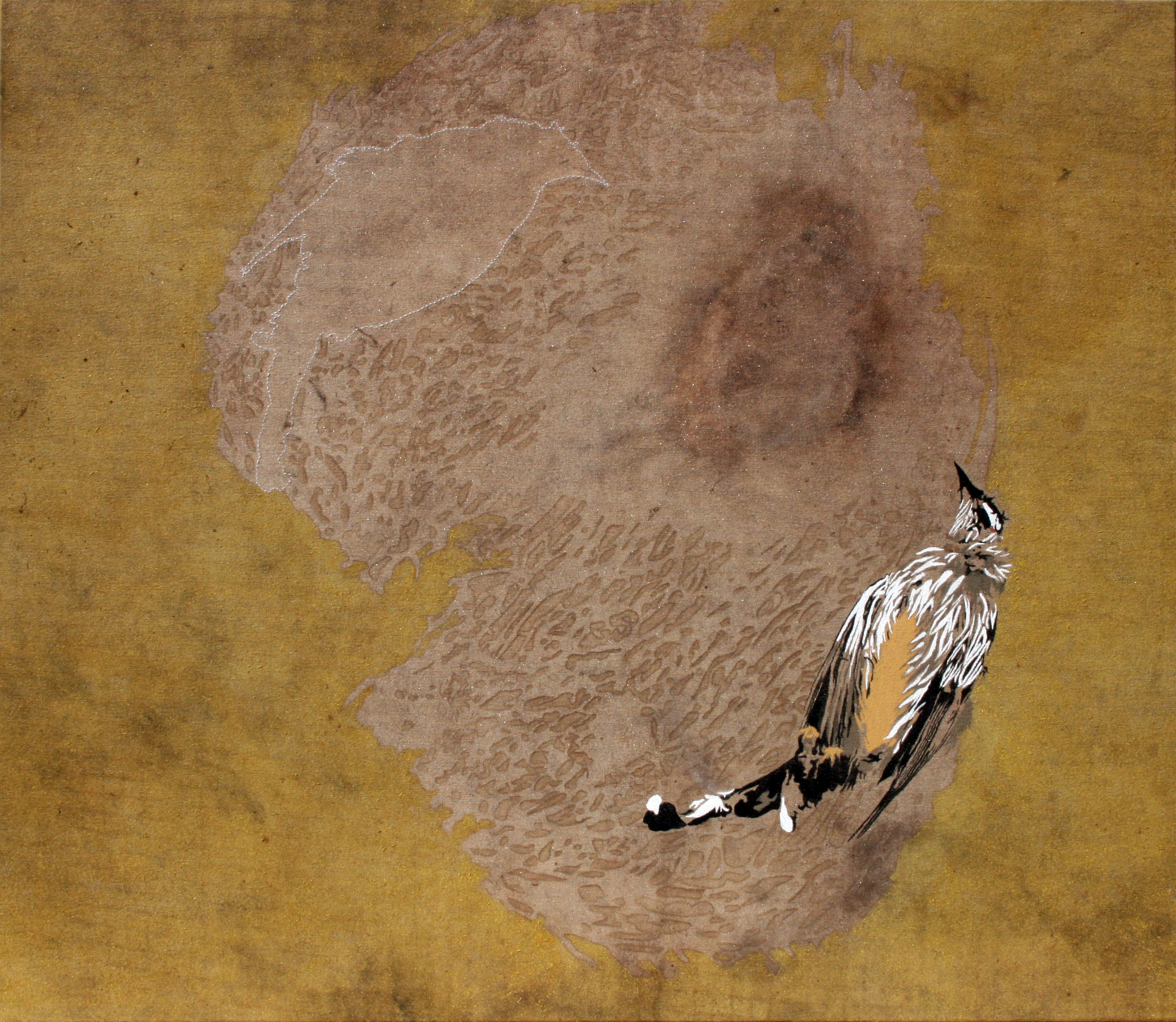
This work began as an installation at my exhibition Dead Beauty to demonstrate the process behind the creation of the shroud image. Seeing the body of the magpie upset one lady in particular who stated that animal’s spirit was being disrespected. I wished I had the opportunity to speak to her about it as I wondered if the stretching out of his wings had been the most upsetting. When I moved the shroud installation to a new site only suitable for less abominable decompositions, such as birds and small rodents, there was another complaint due to the nearby creche and an inquisitive child. This new site is conveniently outside my studio under a majestic healthy eucalyptus tree who I hope bleeds sap generously and possums and birds defecate from regularly. This is my first shroud at this new site. I love the result and hope to build up a collection of smaller shrouds for those who prefer to see the images unstretched. I prefer the practicality of a stretched work. Maybe I could even push it with some fish and reptiles although large mammals would be out of the question as I am sure there would be louder complaints. I am yet to create a large installation site in the bush for ambitious tarpaulin works.
Author: Vanessa Barbay
Laomedia visual artist and drummer
coastal shrouds on paper
I found a dead black snake on the way to Booderee and thought of my illustrations for Pauline McLeod about the Little Black Snake who conquers the giant goannas and becomes poisonous by stealing their poison. I placed the partly decomposed snake (nayin) on canvas to continue disintegration. I also placed shrimp leftover from my dad’s fishing trip with my kids. It would be better to stretch the paper first in my sacred waterhole.
Animals of the World
The tragic situation
Hungarian animation
A taste of my Magyar heritage
Abjection in Theory and Art
The definition of abject art on the Tate website notes, “In practice the abject covers all the bodily functions, or aspects of the body, that are deemed impure or inappropriate for public display or discussion.” The definition on the Keterrer Kunst website begins by stating, “Abject art is an art form associated with Material and Object art, and refers to works, which contain abject subjects, materials and substances.” Julia Kristeva posited the term abject in her essay on abjection Powers of Horror first published in French in 1980 and English in 1982. She introduces abjection as “Loathing an item of food, a piece of filth, waste, or dung.” (2PH). Most contemporary artists working with abjection focus on the human body, often their own as Performance art or Body art became a common way for artists to actively assimilate the abject in front of an audience.
Dead Beauty Exhibition
I have an exhibition on in the Foyer Gallery of the School of Art this week.
It consists of 20 raw shrouds stretched onto wooden frames and sized with rabbit skin glue and a shroud in process outside featuring a magpie. My artist statement:
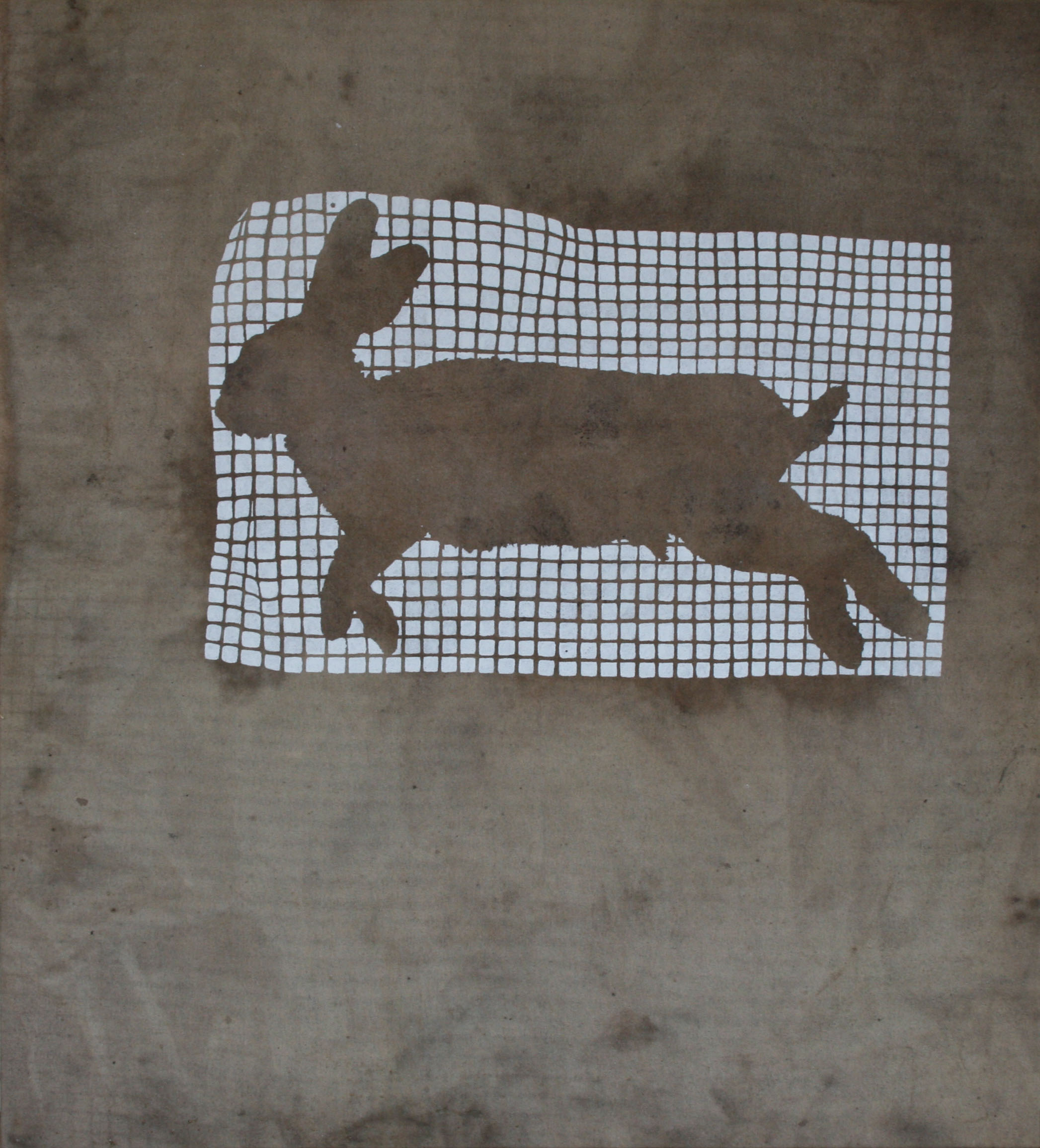
The decomposition print or shroud is a bodily stain that captures the rapid breaking down of the body after death. This is a process shared by human and non-human animals reminding us of our mortality and animality. Rotting flesh is repulsive to our sensory organs and taboo in our hypoallergenic society. The notion of the abject or abhorrent in art challenges our distinction between object and subject. An object is perceived as a thing used for a purpose, a subject is one who has agency and rights we can identify with. The representation of animals is a contentious issue at a time when the modern perception of animal as object is being challenged. In my work I experience the assimilation of the abject, the rancid object, a dead body, becomes a subject as I capture the essence of individual disintegrating forms and present them in a painting format to be venerated.
2nd Spring shroud set
It was a very windy cold day for summer and we arrived at the farm to see Steven and Tony. We had the trailer as we had decided to pack up the installation with the idea of setting it up on top of Tumbarumba Mountain. A long time ago we bought shares in the land to save it from logging so it is original forest with large gums. I intend to include more plant matter on these next sets over summer.
The second spring set was exquisite. It had been left for 6 weeks in storms and wind and the colourful birds had melted with their feathers neatly placed. I would have liked to have sewn them on, but it would have to be done on site as they would fall apart, another reason for Tumbarumba as it is a great camping spot to spend time. We could set up a processing area too using eucalyptus and having a line undercover so I do not have to process on my washing line at home. If there was a small shed installed I could have bodies drying out inside too.
One of the possum pairs had been stained a beautiful yellow from the tree and I imagined a lot more staining in a eucalyptus forest.
Timescape
Julie, Ella and I have a group exhibition at M16 in Griffith, Canberra.




Art Informel
I recently discovered artists and a movement I know little about, but found inspirational at this apparently transitional point in my project. Although a tendency throughout Europe during the early 1950s, it seems to blossom in Italy. The artist which first attracted me to the period is Alberto Burri whose sack collages and burnt plastic seemed so simple yet powerful as matter takes precedence. Exploring further I find a text Beyond Painting: Burri, Fontana, Manzoni 2005, by Matthew Gale and Renato Miracco, and discover similar motivations or goals to this Italian trio which was unexpected. It originates within the ideas of the Futurists but is most clearly expressed in the writings of artist Enrico Prampolini who states, “To become matter: the concept of metamorphosis underlies the creation of the elements in a composition in a conceptual process of spiritual transfiguration and formal transposition.” (Arte polimaterica 1944) I again think of the shroud process. My dilemma is how to continue working on the shrouds adding new matter equivalent in value to the bodily stain. It is useful for me to currently build on my practice in the following terms as I, like Prampolini, view paint as matter and therefore any matter as a potential painterly substance:
“Prampolini was the first Italian artist to question the difference between the use of material and being in matter…matter was an object in itself. It was a fragment of a past and present life, rendered rich and evocative either through its own material qualities, or through its juxtaposition and relationship with other materials. From this juxtaposition arose a revelation of various sorts, equal to the ‘flashes of inspiration of “ordinary things”…[that, when they] illuminate art, create these elements which are most essential to our everyday reality.’…it is defined, in essence, by different types of matter, by their intrinsic qualities, and the relationship established between them. These polymaterials became known as (‘encounters with matter’ or literally ‘interviews with matter’, terms coined by Prampolini). In 1944 he wrote: ‘Encounters with matter were not about a battle against painting, but about taking to its extreme the idea of substituting completely and fundamentally the reality of paint with the reality of matter’. This explicit difference, which forms the basis for a coherent revisionist dialogue between artist and viewer, allows the viewer to distinguish completely a painted reality from a material reality, so that both can co-exist. The work of art is thus no longer confined arbitrarily within a pictorially defined dimension, but is able to extend towards a reality that can also be founded on matter. ‘Polymaterial art is not a technique but a rudimentary means of artistic expression’, Prampolini stated, ‘the evocative power of which resides in the formal arrangement of matter…Matter being something inherent within the natural world (a living organism, consisting of atoms in perpetual motion) as well as having formal transcendence…Matter can be made spiritual and harmoniously arranged over surfaces in space, where the lively and direct juxtaposition of different materials raises to a higher level the human vision of our era.’”[p.20-1]
Camera Lucida 1981
Reading Roland Barthes insights concerning the affect of photography prompted me to consider the shroud, passages seem to describe the affect of the decomposition print more than photography. Simply replace ‘photography’ with ‘shroud’ For example,
“Since Photography [a shroud]…authenticates the existence of a certain being, I want to discover that being in the Photograph [shroud] completely, i.e., in its essence, “as into itself…” beyond simple resemblance…something inexpressible: evident…yet improbable (I cannot prove it). This something is what I call the air (the expression, the look). The air of a face is unanalyzable (once I can decompose, I prove or I reject, in short I doubt, I deviate from the Photograph [shroud], which is by nature totally evidence: evidence is what does not want to be decomposed). The air is not a schematic, intellectual datum, the way silhouette is. Nor is the air a simple analog – however extended – as is “likeness”. No the air is that exorbitant thing which induces from body to soul – animula, little individual soul, good in one person, bad in another…The air…is a kind of intractable supplement of identity, what is given as an act of grace, stripped of any “importance”: the air expresses the subject, insofar as that subject assigns itself no importance…And mysteriously, this coincidence is a kind of metamorphosis…suddenly the mask vanished: there remained a soul, ageless but not timeless, since this air was the person I used to see…Perhaps the air is ultimately something moral, mysteriously contributing to the face the reflection of a life value?…Thus the air is the luminous shadow which accompanies the body; and if the photograph [shroud] fails to show this air, then the body moves without a shadow, and once this shadow is severed, as in the myth of the Woman without a Shadow, there remains no more than a sterile body.” [p.107-110]
 Laomedia